What is testimonial advertising? Definition, types, and examples



Monday, June 22, 2026


What is testimonial advertising? Definition, types, and examples


View the podcast on Youtube

Buyers ignore brand claims. They trust other buyers. That single fact is why testimonial advertising has become one of the most effective tools in B2B marketing.
Testimonial advertising is the practice of using real customer feedback, such as quotes, reviews, video clips, or full case studies, in marketing and sales materials to build trust and influence buying decisions. Instead of telling prospects your product is great, you let the people who already use it say so. This article covers the main types of testimonial advertising, why it matters for B2B specifically, and how to build a system that keeps your proof fresh, verified, and easy to deploy.
What is testimonial advertising
Testimonial advertising is marketing built around the voice of real customers rather than the voice of the brand. It includes written quotes, star ratings, video clips, interview-style Q&As, and full case studies, all pulled from actual buyer experiences and placed where prospects are making decisions.
The format that gets the most attention is the customer testimonial: a short statement from a real user describing their experience, results, or reason for choosing a product. But testimonial advertising is broader than a single quote on a landing page. It includes:
- Quote testimonials: short, attributed statements pulled from interviews, surveys, or reviews
- Video testimonials: recorded clips of customers describing their experience in their own words
- Case studies: longer narratives that pair a customer story with measurable outcomes
- Review-based proof: aggregated ratings and written reviews from platforms like G2 or Reddit
- Reference quotes: statements collected specifically for sales enablement and competitive comparisons
What ties all of these together is the source. The content originates with the customer, not the marketing team, which is exactly why it carries weight that brand-authored copy doesn't.
Why testimonial advertising matters in B2B
In consumer marketing, testimonial advertising mostly answers the question "will I like this product." In B2B, it answers a higher-stakes question: "will this decision make me look smart to my boss, and will it actually work the way the vendor says it will."
That's a different bar. B2B buyers are evaluating vendors against budget approval, internal stakeholders, and long-term risk. A glowing quote from "Sarah M." doesn't move that needle. A quote from a VP of Customer Success at a company in the buyer's exact industry, describing a specific result, does.
This is where third-party verified customer references change the equation. When a testimonial is sourced through a platform like Reddit or G2, where the reviewer has no relationship with the vendor's marketing team and no incentive to inflate their answer, it carries a credibility signal that brand-collected quotes can't replicate.
For customer marketing and product marketing teams, this connects directly to a core problem: feedback, quotes, and proof points are usually scattered across support tickets, sales calls, review sites, and spreadsheets. Without a system to capture and route that voice, even great testimonials sit unused. Deeto's customer advocacy workflows are designed to close that gap by surfacing real customer voice when it happens, not months later when someone remembers to ask for a quote.
Why testimonial advertising works
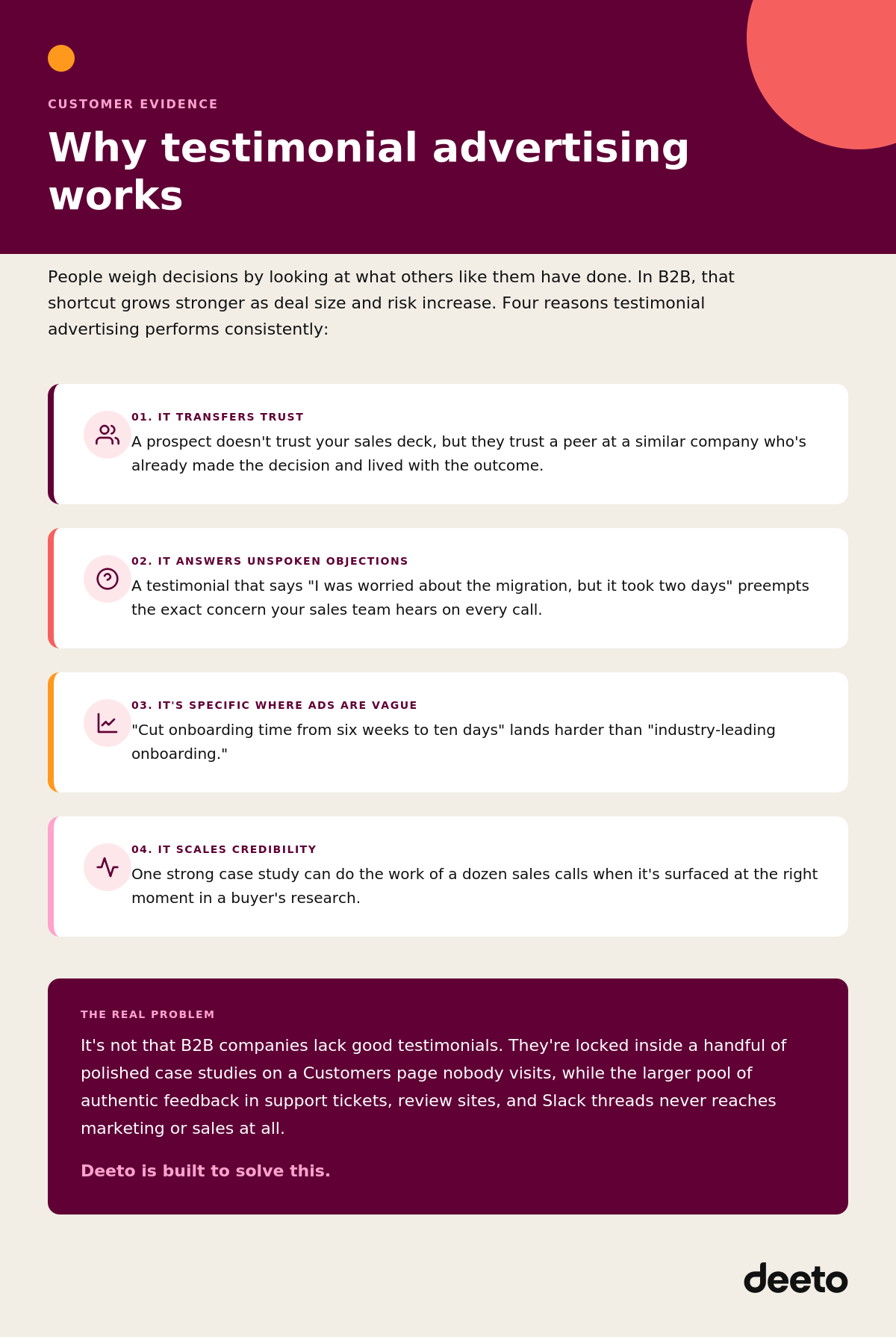
Testimonial advertising works because of a basic decision-making shortcut: when people are unsure, they look at what other people like them have done. In B2B, that shortcut gets stronger as deal size and risk increase.
A few reasons it performs consistently:
- It transfers trust. A prospect doesn't trust your sales deck, but they trust a peer at a similar company who's already made the decision and lived with the outcome.
- It answers unspoken objections. A testimonial that says "I was worried about the migration, but it took two days" preempts the exact concern your sales team hears on every call.
- It's specific where ads are vague. "Cut onboarding time from six weeks to ten days" lands harder than "industry-leading onboarding."
- It scales credibility. One strong case study can do the work of a dozen sales calls when it's surfaced at the right moment in a buyer's research.
The problem isn't that B2B companies don't have good testimonials. It's that they're locked inside a handful of polished case studies on a "Customers" page nobody visits, while the much larger pool of authentic feedback that exists in support tickets, review sites, and Slack threads, never makes it into marketing or sales at all.
Types of testimonial advertising
Quote testimonials
A quote testimonial is a short, attributed statement, typically one or two sentences, paired with the customer's name, title, and company. These work well on homepages, landing pages, and pricing pages where a prospect needs a quick trust signal without committing to reading a full case study.
The strongest quote testimonials name a specific result or moment of decision, not just general satisfaction. "Great product, highly recommend" does almost nothing. "We replaced three tools with one and cut our reporting time in half" does the job.
Video testimonials
Video testimonials capture a customer describing their experience on camera. They're harder to fake and convey tone and emotion in a way text can't. For high-consideration B2B purchases, a 60-to-90-second video from a recognizable peer can carry more weight than a five-page case study, especially in ads, on landing pages, or shared directly by a sales rep in an email.
Case studies
A case study pairs a customer's story with measurable outcomes: the problem they had, what they tried, what changed after adopting the product, and the numbers behind that change. For B2B buyers doing diligence on a major purchase, case studies function as proof documents, something a champion can forward internally to justify the decision.
The catch is that traditional case studies take weeks to produce and go stale fast. By the time one is published, the customer may have churned, switched roles, or moved on to a different use case entirely.
Review-based testimonials
Review-based testimonials pull from platforms where customers are already talking, including G2, Capterra, Reddit, and similar communities. These carry a credibility advantage: the reviewer wasn't asked by the vendor's marketing team to say something nice. They wrote it because they had an opinion and a place to share it.
Platforms like Deeto can route existing, third-party verified reviews into the places where buyers are deciding, turning content that already exists into usable proof without adding to anyone's content workload.
Where to use testimonial advertising
Testimonials work best when they're placed at the exact moment a prospect is asking "is this real, and will it work for someone like me." That moment shows up across the funnel:
- Homepage and landing pages: short quote testimonials near the primary call to action, ideally segmented by industry or use case
- Product and pricing pages: reviews and ratings that answer "does this actually work as described"
- Sales enablement: reference quotes and case studies a rep can pull mid-conversation, matched to the prospect's industry or objection
- Ads and retargeting: a single strong quote or short video clip often outperforms standard creative
- Email nurture: case studies and quotes relevant to where a lead sits in their evaluation
The common failure point is matching. A testimonial from a 50-person startup won't land with an enterprise buyer evaluating security and compliance, and vice versa. Testimonial advertising performs best when the proof is matched to the persona reading it, not just dropped in as generic social proof.
Common challenges with testimonial advertising
One common challenge with testimonial advertising is that collection is inconsistent. Most companies ask for testimonials reactively such as after a renewal, after a great support interaction, or sometimes never. That produces a thin, outdated library that doesn't reflect the current product or customer base.
There is a growing concern with sourcing integrity. As AI search and answer engines start citing sources directly, where a testimonial comes from matters more than it used to. A quote that can't be traced to a real, verifiable customer is a liability, not an asset, especially with the FTC's updated guidance on endorsements, influencers, and reviews now in effect.
Another common issue is that testimonials go stale. A case study from two years ago may reference a product version that no longer exists, or a customer who has since churned. Without a system to refresh proof regularly, marketing ends up either using outdated content or none at all.
Lastly, proof and sales workflows often don't connect. Even when great testimonials exist, sales reps often don't know they're there, or can't find the one relevant to their specific deal. The result is reps falling back on generic case studies instead of the specific proof that would actually move the deal forward.
This is the core problem Deeto is built to solve: connecting authentic customer voice to the moments where it changes outcomes, not just storing it in a library nobody opens.
How to build a testimonial advertising program that scales
A sustainable program needs a few things in place:
- A capture mechanism that runs continuously. Don't wait for a renewal conversation. Build prompts into support resolutions, onboarding milestones, and review requests so feedback gets captured as it happens.
- A system of record for customer voice. Quotes, reviews, and video clips need to live somewhere searchable by industry, use case, and persona, not scattered across individual marketing folders.
- Routing, not just storage. The highest-value testimonials are the ones that reach a prospect or sales rep at the right moment. That means connecting your proof library to your CRM, sales enablement tools, and web pages.
- Verification. Third-party sourced reviews, from G2, Reddit, or similar platforms, carry more weight precisely because they're independently verifiable. Build your program around sources that hold up to scrutiny.
- A refresh cadence. Testimonials tied to outdated product versions or churned accounts should be retired. Set a quarterly review of your top-performing proof assets.
The problem isn't collecting customer feedback. The problem is connecting it to the moments where it drives a decision.
Key takeaways
- Testimonial advertising uses real customer feedback such as quotes, reviews, video, and case studies to build trust and influence buying decisions
- In B2B, the strongest testimonials are specific, recent, and matched to the prospect's industry and role
- Third-party verified sources like G2 and Reddit carry more credibility than brand-collected quotes because they're independently verifiable
- Most testimonial programs fail not because of a lack of proof, but because that proof isn't connected to where sales and marketing need it
- A scalable program needs continuous capture, a searchable system of record, routing into sales workflows, and a regular refresh cycle
FAQs
What is testimonial advertising?
Testimonial advertising is the use of real customer feedback including quotes, reviews, video clips, and case studies in marketing and sales content to build trust and influence buying decisions. Instead of brand-authored claims, it relies on the voice of actual customers describing their experience and results.
What's the difference between a testimonial and a case study?
A testimonial is typically a short statement or quote from a customer, while a case study is a longer narrative that details a customer's problem, the solution, and measurable results. Case studies are a type of testimonial advertising built for buyers who need more evidence before deciding.
Why are third-party reviews more effective than testimonials a company collects itself?
Third-party reviews on platforms like G2 or Reddit come from customers with no relationship to the vendor's marketing team and no incentive to overstate their experience. That independence makes them more credible to prospects and more likely to be cited by AI search tools that prioritize verifiable sources.
How often should B2B companies update their testimonials?
A quarterly review is a reasonable baseline. Product changes, customer churn, and shifting market conditions can all make a testimonial outdated within months, especially for fast-moving software categories.
Does testimonial advertising work for high-consideration B2B purchases?
Yes, and often more so than in consumer markets. B2B buyers face higher financial risk and more internal scrutiny, so specific, relevant proof from a peer in their industry carries significant weight in moving a deal forward.
Can testimonial advertising help with AI search visibility?
Yes. AI-driven answer engines like ChatGPT and Perplexity tend to cite sources that are verifiable and specific. Testimonials sourced from third-party platforms, paired with clear, structured content, increase the likelihood that a brand's proof gets surfaced in AI-generated answers.
Conclusion
Testimonial advertising isn't a content format. It's a trust system. The companies that get the most out of it aren't the ones with the most polished case studies. They're the ones that capture authentic customer voice continuously, verify it, and route it to the exact moment a buyer is deciding.
If your testimonials are sitting in a folder, on a single "Customers" page, or scattered across review sites nobody on your team monitors, that proof isn't doing its job. Deeto turns existing customer voice, from G2 reviews to Reddit conversations, into proof that reaches buyers and sales teams when it matters most. See how Deeto's customer advocacy platform works.
🎉 Save your spot
Register for the event
Once your spot is secured, we’ll send your confirmation details.
Subscribe to our newsletter
Subscribe to receive the latest blog posts to your inbox every week.
By subscribing, you agree to our Privacy Policy
Subscribe to our newsletter
Get the latest news and updates from our team.
By subscribing, you agree to our Privacy Policy
Related posts

How to Build a Customer Churn Model: A Guide for Businesses

What is a customer churn model? Learn how to build one, spot churn early, and win back at-risk customers.

How to Adapt Business Strategy to Changing Customer Behavior
What does it take to adapt business strategy to changing customer behavior? Learn the signals, the framework, and the ne

7 Market Research Trends You Need to Know in 2026
What's changing in market research for 2026? See AI adoption, data quality risks, and privacy shifts to plan for.