What to Ask in a Customer Feedback Questionnaire (And Why Generic Questions Fail)



Tuesday, June 2, 2026


What to Ask in a Customer Feedback Questionnaire (And Why Generic Questions Fail)


View the podcast on Youtube

A customer feedback questionnaire is a structured set of questions sent to customers to understand their experiences and needs. Done right, it gives companies a direct line to what's working and where the real risks live. Done wrong, it's a five-minute form with ten checkbox questions and an NPS score that gets exported to a spreadsheet, summarized in a quarterly deck, and ignored until next quarter.
This article covers what to ask, why most feedback strategies miss the mark, and how to design questions that produce insight your team can actually use.
What is a customer feedback questionnaire?
A customer feedback questionnaire is a tool companies use to gather structured input directly from customers. It can take the form of a post-onboarding survey, a quarterly check-in, a product feedback form, or an exit interview. The goal: understand what customers think and need.
These questionnaires help teams across the organization. Customer success uses them to spot churn risk early. Product uses them to prioritize the roadmap. Marketing sharpens messaging from them. Sales uses the outputs to build credibility with prospects.
The problem isn't volume. Most companies collect plenty of feedback. The challenge is that what they collect is too generic to share, act on, or build from.
Why most feedback questionnaires don't work
Most companies have more feedback than they know what to do with. The gap between teams that grow from it and those that don't isn't about how much they collect, it's about whether the questions are specific enough to produce insight anyone can use.
Static questionnaires ask every customer the same thing. A startup that just completed onboarding gets the same questions as an enterprise customer renewing their third contract. A churned customer gets the same form as a brand advocate. The result is data that averages everything and explains nothing.
A questionnaire that actually drives decisions asks questions relevant to where the customer is in their lifecycle, and is specific enough to their experience that they actually want to answer. Picking five questions from a generic list gets you none of that.
The core categories of questions to ask for surveys
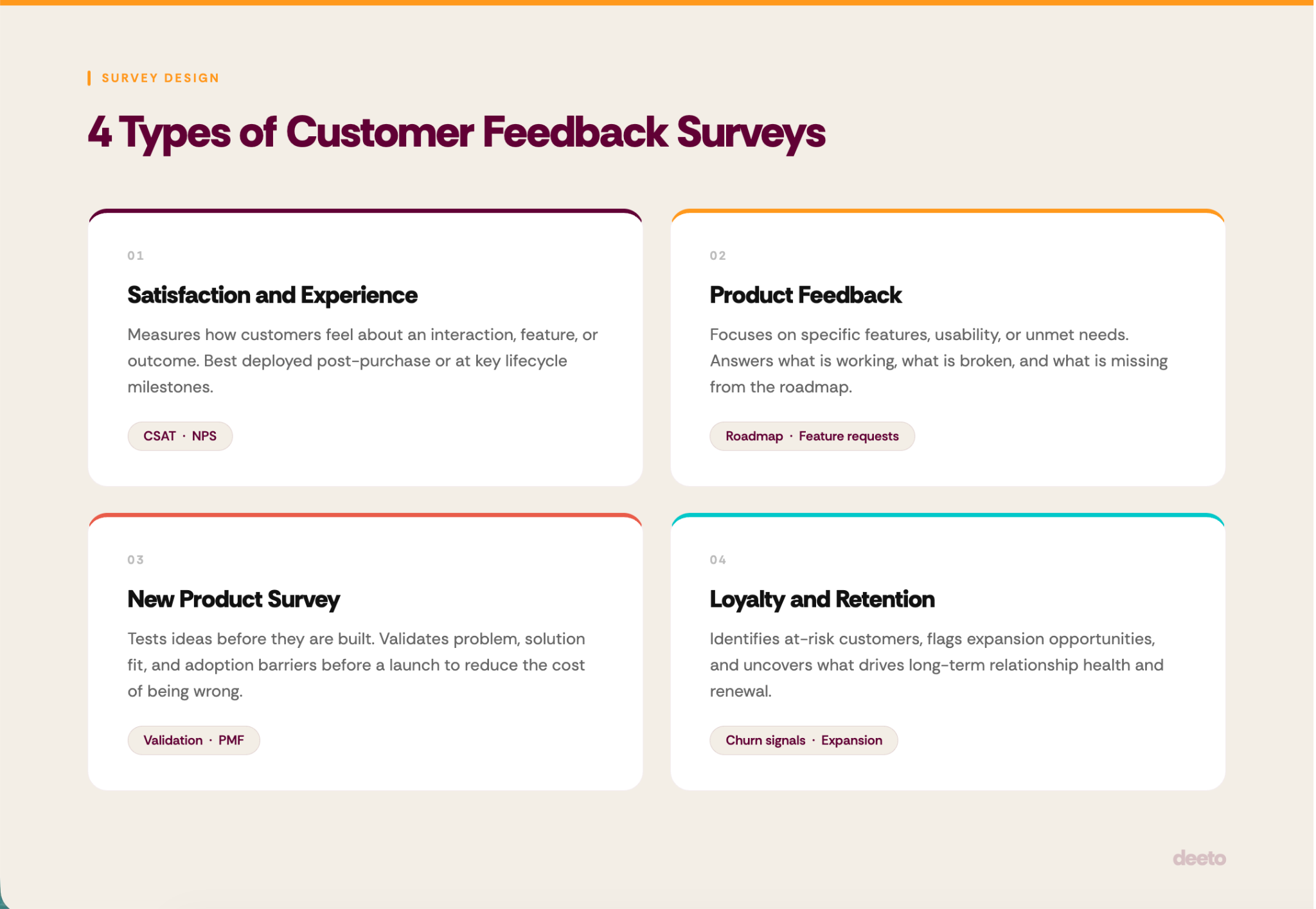
Not all surveys serve the same purpose. Before writing a single question, decide which of these four categories your questionnaire belongs to.
- Satisfaction and experience surveys: These measure how customers feel about an interaction, feature, or outcome. These are your CSAT and NPS touchpoints which are best deployed at key lifecycle milestones.
- Product feedback surveys: These focus on specific features or unmet needs. They can tell you what is working and what is not. These feed directly into roadmap decisions.
- New product surveys: Allow you to test ideas before they are built or validate assumptions before a launch. They are essential for reducing the cost of being wrong.
- Loyalty and retention surveys: Helps you identify customers at risk, flag expansion opportunities, and uncover what drives long-term relationship health.
Each category calls for different questions. A retention survey should not look like an NPS survey. Know your goal before you write the first line.
Questions to include in a customer feedback questionnaire
These are the most effective questions across the core survey types. Use them as a starting framework, not a copy-paste script. Adapt the language to match your product, your customer, and the specific moment in the journey.
For overall satisfaction
- On a scale of 0 to 10, how likely are you to recommend us to a colleague or peer?
- How satisfied are you with your experience today? (Rate 1 to 5)
- Did we meet your expectations? If not, where did we fall short?
- What is the one thing we could do differently to improve your experience?
The last question is underused and often the most useful. It forces specificity without anchoring the customer to your assumptions.
For product feedback
- Which features do you use most often?
- Is there anything you expected this product to do that it currently does not?
- What is the biggest friction point in your current workflow?
- If you could change one thing about the product, what would it be?
- How does this product compare to alternatives you have tried?
The comparison question is powerful if you are trying to sharpen competitive positioning. Pair the answers with your win/loss analysis data to get the full picture.
For a new product survey
A new product survey is best run before development starts or immediately after beta access. The goal is to validate whether the problem is real, whether your solution fits, and whether the customer would actually pay for it.
- How do you currently solve [the problem this product addresses]?
- How much time or money does this problem cost you each month?
- What would make you confident enough to switch to a new solution?
- What would a 10 out of 10 version of this product look like for you?
- What would stop you from adopting a product like this?
That last question is the one most teams skip. It is also the one most likely to surface the real objection before it kills your launch.
For customer experience and post-support
- Was your issue resolved today?
- How long did it take to get the help you needed?
- Was the support team easy to work with?
- What could we have done to make this interaction faster or easier?
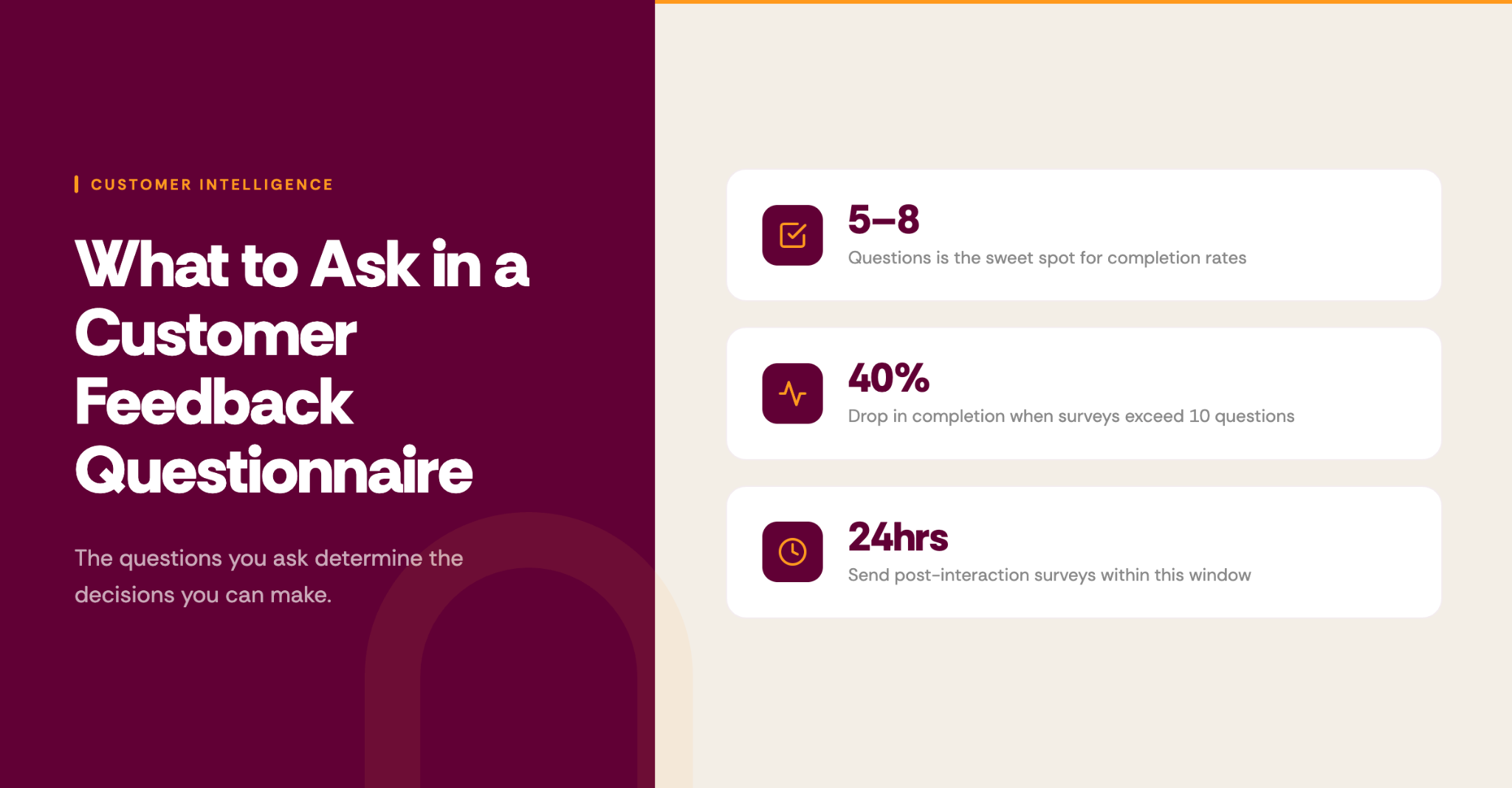
Post-support surveys should be sent within 24 hours of the interaction. Response rates drop sharply after 48 hours.
For churn risk and retention
- How often are you currently using the product?
- Has your usage changed over the past 90 days? If so, why?
- Do you feel you are getting value from your investment?
- What would have to be true for you to expand your use of this product?
- Is there anything that would cause you to consider alternatives?
Customer sentiment analysis at scale starts with questions like these, but the real value comes from identifying patterns across hundreds of responses, not reading individual ones.
Customer survey & questionnaire tools
Typeform and SurveyMonkey are easy to set up and work fine for simple, one-time surveys. They're not designed for ongoing feedback loops or for connecting responses to customer context in your CRM.
Medallia and Qualtrics are enterprise-grade VoC platforms with strong analytics. They're powerful and expensive, require significant implementation work, and still rely on static templates you customize yourself.
Intercom and HubSpot have lightweight survey functionality built in, which works well for embedding a quick question in a product flow or email. Not built for depth.
Deeto works differently. Instead of sending customers a fixed questionnaire, Deeto's Listen module generates question sets tailored to each customer's profile, journey stage, and what your team needs to know right now. A customer in month two of onboarding gets different questions than one approaching renewal. The result is feedback that reflects where the relationship actually is, not a template designed for a customer that doesn't exist.
What actually works
- Timing matters more than most teams realize. Sending a feedback questionnaire at the wrong moment guarantees low response rates and low-quality answers. Post-onboarding completion, after a support interaction, pre-renewal, and at key product milestones are all natural moments. "Quarterly survey" rarely is.
- Five focused questions outperform twenty broad ones. Customers will answer five honest questions. They'll rush through twenty. When you give them the choice between a scale rating and an open field, favor the open field. A customer who writes "I wish your reporting was faster" has given your product team something actionable. A 7 out of 10 hasn't. According to Survicate, surveys with 15 or more questions see completion rates below 42%, compared to over 80% for surveys with just a few questions.
- Close the loop. If you ask customers for feedback and never acknowledge it, you train them to stop sharing. A short follow-up, even just "we saw your feedback and shared it with the product team," improves future response rates and signals that someone is actually listening. According to Forrester's 2024 US Customer Experience Index, companies that put customers at the center of their decisions see 51% better retention than those that don't.
Why generic questions produce generic insight
Static questionnaires are built for average customers, and your customers aren't average.
They're in different industries, at different stages of their relationship with you, running different workflows, sitting on different risks. A question like "How satisfied are you with our product?" means something completely different to a customer in month one than to one in year three.
Generic questions flatten all of that into a single number. They tell you satisfaction is trending at 7.4 this quarter. They don't tell you why your mid-market segment is at 6.1, which features your enterprise accounts still aren't using, or why three of your healthiest accounts haven't responded to anything in 60 days.
Feedback designed for a specific customer has to account for their industry, their lifecycle stage, their product usage, and what your CS or sales team already knows about them. This is why customer sentiment analysis built on checkbox surveys tends to underperform; the inputs aren't rich enough to produce useful outputs.
Deeto solves this by generating unique question sets for each customer rather than defaulting to a static form. The platform knows what stage the customer is in, what signals have come in from previous interactions, and what your team needs to understand right now. What you get back is feedback specific to that customer's situation, and that specificity is what makes feedback worth collecting in the first place.
What to do with the answers
Collecting feedback is the easy part. Acting on it is where most programs break down.
Aggregate before you react. One strong opinion is not a signal. Ten customers saying the same thing is. Wait for pattern, not anecdote, before changing anything.
Tag responses to decisions. Before you send a survey, name the decision it is designed to inform. When responses come in, route them to that decision owner. Feedback that goes into a spreadsheet and stops there is not feedback. It is noise.
Close the loop with respondents. If a customer took five minutes to tell you what is broken, they deserve to know what happened next. Even a one-line follow-up builds more trust than any NPS score you could generate.
Connect feedback to other signals. Survey data is most powerful when it sits alongside your internal product and support data. The customer research use case in Deeto connects survey responses to the broader customer intelligence picture so nothing lives in a silo.
If you are also using feedback to inform your content or messaging strategy, Deeto's product marketing team solution helps PMMs connect what customers actually say to the claims they make in the market.

Key takeaways
A customer feedback questionnaire's value depends entirely on whether questions are relevant to the individual customer's experience. The most useful questions ask about outcomes, product gaps, future priorities, and loyalty rather than general satisfaction.
Timing matters: feedback collected at the right journey moment produces far richer responses than periodic mass surveys. Generic, static questionnaires produce generic insight.
Conclusion
Most feedback programs are really data collection programs. They generate exports, dashboards, and quarterly trend lines. Clear, specific insight tied to individual customer relationships is what they rarely produce.
The right starting point is making your questions relevant enough that customers want to answer them. That means getting specific to the customer's lifecycle stage, their product usage, their business goals, and what your team actually needs to understand.
If you want to see how Deeto helps teams move from static feedback forms to dynamic customer intelligence, book a demo.
Frequently asked questions
What is a customer feedback questionnaire?
A customer feedback questionnaire is a structured set of questions sent to customers to collect input about their experience, satisfaction, product usage, or future needs. It can be delivered via email, in-product, or through a dedicated survey tool. The goal is to surface insight that helps teams across customer success, product, marketing, and sales make better decisions.
What questions should I ask in a customer feedback survey?
The best questions depend on where the customer is in their journey. Key categories include: overall experience and satisfaction, product value and feature usage, support quality, likelihood to recommend or advocate, and future business priorities. Open-ended questions generally produce more specific and usable insight than scale-based ratings alone.
How long should a customer feedback questionnaire be?
Aim for five to eight focused questions per questionnaire. Shorter surveys get higher response rates and more honest answers. Twenty-question forms get rushed responses or no responses at all. Prioritize depth over breadth.
How is a feedback questionnaire different from a static survey?
A static survey sends every customer the same questions regardless of their context. A feedback questionnaire, when designed well, is tailored to the individual customer's lifecycle stage, product usage, and relationship history. The more relevant the questions, the more useful the answers.
Why do customers stop responding to feedback requests?
Usually because nothing appears to change after they respond. Closing the loop, even with a simple acknowledgment, dramatically improves future participation. Customers also disengage when questions feel irrelevant to their actual experience, which is why personalization matters.
How does Deeto approach customer feedback questionnaires differently?
Deeto generates dynamic, AI-driven question sets tailored to each customer rather than using a fixed template. The platform accounts for the customer's journey stage, previous interactions, and what the team needs to understand at that moment. This means every customer gets questions that reflect their specific situation, producing feedback that's richer and more specific than a standard survey.
🎉 Save your spot
Register for the event
Once your spot is secured, we’ll send your confirmation details.
Subscribe to our newsletter
Subscribe to receive the latest blog posts to your inbox every week.
By subscribing, you agree to our Privacy Policy
Subscribe to our newsletter
Get the latest news and updates from our team.
By subscribing, you agree to our Privacy Policy
Related posts

Omnichannel Customer Engagement Tools: 8 Platforms Compared

Compare 8 omnichannel engagement platforms on channels, AI, and pricing, plus the gap automation can't fill.

Call Intelligence Software That Spots Your Next Reference
What is call intelligence software? Learn how it scores every call automatically and surfaces advocacy-ready customers.

4 Ways To Leverage Social Proof In Marketing
What is social proof in marketing? Learn 4 ways to use reviews, stories, and advocacy to build buyer trust.