How to build signal-based marketing plays



Wednesday, June 24, 2026


How to build signal-based marketing plays


View the podcast on Youtube

Many B2B teams still market to their entire total addressable market the same way, regardless of whether an account is ready to buy or six months out from caring. That's where signal-based marketing comes in.
Signal-based marketing is a strategy that uses real-time buyer behavior, account activity, and intent data to identify which accounts are actively in-market right now, then triggers targeted outreach based on what they're doing. Instead of treating every "good fit" account the same, you build plays around the specific actions that indicate someone is closer to a buying decision.
This guide covers what counts as a signal, the categories of signal data worth tracking, a framework for building your first signal-based play, and where most programs go wrong.
What is signal-based marketing
Signal-based marketing means using behavioral, firmographic, and intent data to figure out which accounts in your total addressable market are showing buying readiness, then adjusting your outreach and content based on those specific signals.
A "signal" can be almost anything an account does that suggests interest or change: visiting your pricing page three times in a week, a champion changing jobs, a new executive hire, a competitor comparison search, or a spike in reviews from companies similar to your target accounts.
The core idea is simple. Signal-based marketing replaces static lead scoring with dynamic, real-time triggers. A company that fits your ideal customer profile on paper but shows zero activity gets a different treatment than one that fits the profile and just downloaded a competitor comparison guide.
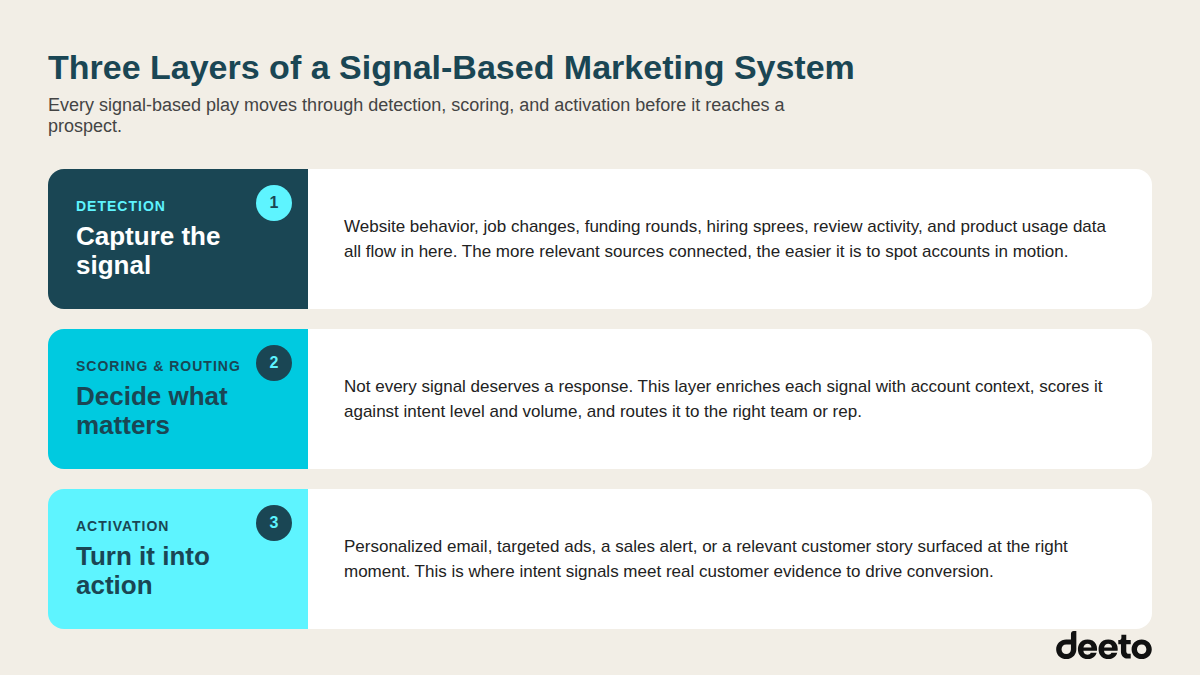
Signal-based marketing systems typically run on three layers:
- Detection: Capturing the raw signal such as website behavior, a job change, a funding round, or a review left on G2 or Capterra
- Scoring and routing: Deciding which signals matter enough to act on, and who should act on them
- Activation: Turning the signal into a specific action, like a personalized email, a targeted ad, or a sales alert
Why signal-based marketing matters now
Most accounts in your TAM aren't ready to buy at any given moment. Spraying the same messaging across all of them wastes budget and burns out your audience.
A few shifts have made signal-based approaches more useful. First, buyers do most of their research before talking to sales. By the time a prospect fills out a form, they've often already formed an opinion based on reviews, peer recommendations, and content they found on their own.
Second, cookie deprecation has made traditional retargeting less reliable. Behavioral and intent signals fill some of that gap by giving you a reason to reach out that isn't dependent on third-party tracking.
Additionally, buying committees are larger and slower. Enterprise deals now involve 11 or more stakeholders on average, according to Gartner. When multiple stakeholders at the same account start engaging, that's a stronger signal than any single person's activity. A spike in activity across several people at one account is worth more than a single high-scoring lead.
Lastly, the "dark funnel" hides most research activity. Prospects compare vendors on review sites, in private Slack communities, and through peer conversations you can't track. Signal-based marketing depends on surfacing as much of that hidden activity as possible.
One thing worth noting: most signal-based marketing conversations focus on intent data platforms, job-change tracking, and website behavior. Those are useful, but they tend to miss one of the stronger signals available, which is what your own customers are saying about you publicly, in reviews, and in conversations with prospects.
Common challenges with signal-based marketing
Teams trying to build signal-based programs run into a handful of recurring problems.
One of the most common challenges is having too many signals with no prioritization. It's easy to connect five intent tools and end up with thousands of weekly alerts and no clear plan for which ones deserve a response.
Another common problem is collecting signals without context. A notification that "Acme Corp visited your pricing page" doesn't tell a rep anything useful on its own. Without context about who visited, what else that account has done, and whether there's an existing relationship, reps either ignore the alert or chase it blindly.
Lack of communication and common goals between teams is another popular issue. Marketing and sales working from different signal definitions. If marketing considers a content download a strong signal and sales considers it noise, the handoff breaks down and reps stop trusting the alerts entirely.
Lastly, it’s easy to miss the signals that come from your own customer base. Most signal stacks are built around external intent data, but they overlook internal signals like which existing customers are actively leaving reviews, referring peers, or showing renewal risk. Those signals are often cheaper to act on and more reliable, because the relationship already exists.
A framework for building your first signal-based play
You don't need to overhaul your entire GTM motion to get started. Build one play, prove it converts, then expand.
1. Pick one signal worth acting on
Choose a signal based on three things:
- Volume: Enough activity to learn from, but not so much that it overwhelms your team. A manageable starting range is roughly 20 to 50 qualified signals per week.
- Intent level: Signals that indicate active research, not casual browsing. A prospect comparing vendors on G2 is further along than someone who opened a newsletter.
- Actionability: A clear next step. If a signal fires and nobody knows what to do with it, it's not worth tracking yet.
A useful starting point for many B2B teams is review activity from prospects researching your category, particularly when it overlaps with companies that already have champions or advocates inside your customer base. This connects directly to customer advocacy work that's likely already in motion.
2. Map the signal to a specific workflow
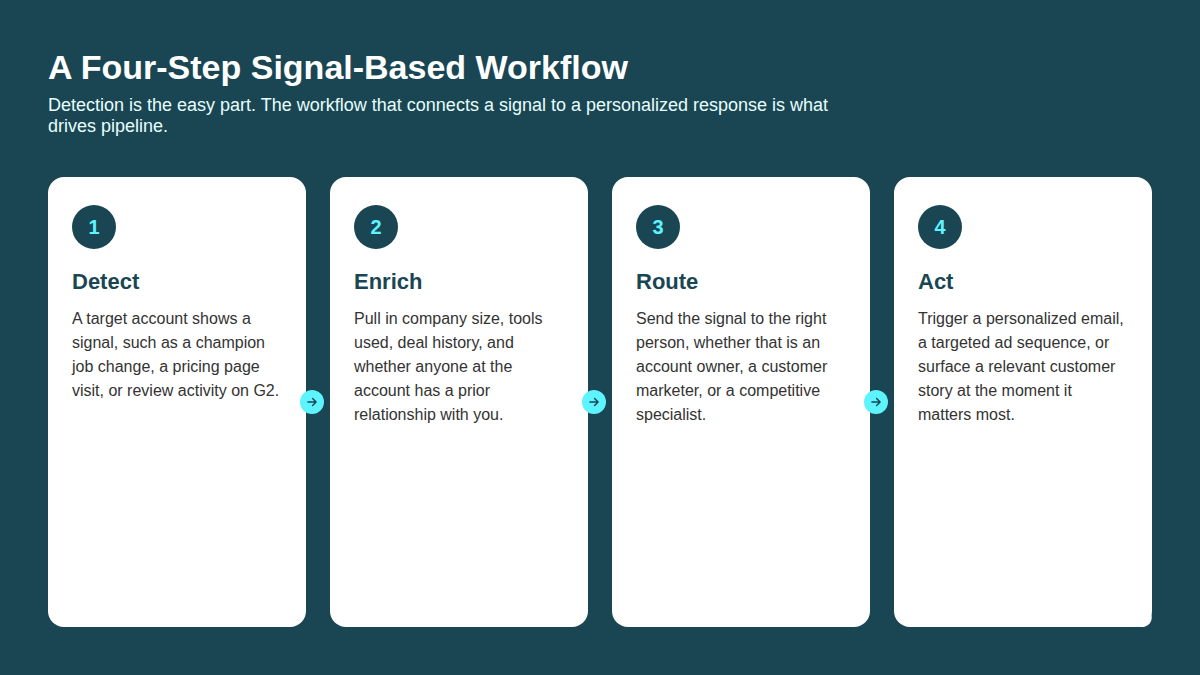
Define exactly what happens when the signal fires:
- Detect: The signal triggers. For example, a target account starts reading reviews in your category, or a champion at a customer account gets promoted
- Enrich: Pull in context automatically, including company size, current tools, deal history, and whether anyone at the account has interacted with your brand before
- Route: Send the signal to the right person, whether that's an account owner, a customer marketer, or a competitive displacement specialist
- Act: Trigger the response, such as a personalized email referencing the specific signal, a targeted ad sequence, or a request for a customer reference
This is where most programs stall. Detection is the easy part. The workflow that connects detection to a personalized, relevant response is what actually drives pipeline. Lifecycle automation handles this connective work, so a signal doesn't just sit in a dashboard.
3. Align marketing and sales on what counts as a signal
Signal-based marketing only works if both teams agree on definitions and ownership. Build shared visibility into which signals exist and where they come from, who owns the response for each signal type, and what "good" looks like so reps trust the alerts instead of ignoring them.
Pull data from closed-won deals to show which signals actually preceded a purchase. If a meaningful share of last quarter's wins involved accounts that had engaged with a customer story, read a peer review, or had a champion vouch for the product, that's evidence worth sharing with the team.
4. Measure, then expand
Track conversion rates by signal type for the first 60 to 90 days. Some signals will outperform others. Double down on what's converting, retire what isn't, and only then add a second signal to the mix.
Best practices for signal-based marketing plays
- Give every signal context. A signal without supporting information forces the rep to do research before they can act. Pair each alert with relevant account history, existing relationships, and any related customer trends so the person acting on it has the full picture immediately.
- Build suppression rules. If an account triggers multiple signals in a short window, combine them into one outreach instead of sending several disconnected messages. Signal fatigue on the prospect's end undermines the whole strategy.
- Set decay windows. A signal from 60 days ago doesn't carry the same weight as one from this week. Define how long each signal type stays "active" before it's archived or requires manual review.
- Use signals your competitors aren't watching. Most signal-based marketing strategies focus on the same handful of data sources: intent platforms, job changes, and website behavior. Reviews, customer feedback patterns, and advocacy activity are signals too, and they're often underused because they live in a different system than the rest of the GTM stack.
This is one area where Deeto fits into a signal-based strategy differently than a typical intent data provider. Deeto's Listen module captures authentic customer voice continuously, while Analyze turns that voice into patterns your team can act on, including sentiment shifts, advocacy readiness, and churn risk that come from real customer relationships rather than third-party data.
How customer evidence becomes a signal
A customer who leaves a strong review, agrees to a reference call, or shows high product engagement isn't just a satisfied account. They're a signal.
Customer evidence signals include:
- A customer leaving a positive review on G2 while a prospect from a similar company is actively comparing vendors
- An advocate willing to do a reference call for an account in the same vertical or use case
- A spike in product engagement or NPS from accounts that match your ideal customer profile, which can indicate expansion readiness
These signals matter because they're high-trust. A prospect comparing vendors who sees a relevant customer story, a third-party verified review, or gets connected to a peer reference is responding to social proof at the exact moment they're deciding. Stories and social proof become part of the activation layer of a signal-based play, not just static content on a website.
For demand gen and growth teams, this connects intent signals to conversion. A prospect showing buying intent who then sees a relevant, recent, verified customer story converts at a meaningfully higher rate than one who sees generic messaging. It's part of why demand generation teams are increasingly involved in customer evidence programs, not just customer marketing.
Key takeaways
- Signal-based marketing uses real-time behavioral, firmographic, and intent data to prioritize accounts showing active buying intent, instead of treating your whole TAM the same way
- Start with one signal that has manageable volume, clear intent, and an obvious next action
- Map every signal to a full workflow: detect, enrich, route, act. Detection alone doesn't drive pipeline
- Internal signals from your customer base such as reviews, advocacy activity, and reference readiness, are often underused compared to third-party intent data
- Pair intent signals with relevant customer evidence at the moment of activation to lift conversion rates
How to implement signal-based marketing with Deeto
Most signal-based marketing guides stop at detection and routing. The activation layer, AKA what you actually say or show a prospect once a signal fires, often gets the least attention.
Deeto's reference management capabilities mean that when a signal indicates an account is actively evaluating vendors, your team can surface a relevant, verified customer story or connect them with a peer reference without manually digging through spreadsheets. Combined with Activate, which delivers the right customer insight to the right person at the right moment, customer evidence becomes part of the signal response itself.
If you're building out a signal-based program and want the customer evidence side to keep pace with your intent and behavioral signals, book a demo to see how Deeto fits into the activation layer of your existing stack.
FAQs
What is signal-based marketing?
Signal-based marketing is a strategy that uses real-time data about buyer behavior, account activity, and intent to identify which companies are actively in-market and ready for outreach. Instead of treating every account in your target market the same, teams build specific plays triggered by signals like website activity, job changes, funding events, or review activity.
What's the difference between signal-based marketing and intent data?
Intent data is one input into signal-based marketing. It typically refers to third-party data showing which companies are researching topics related to your category. Signal-based marketing is the broader strategy that combines intent data with first-party behavioral data, relationship signals, and internal data like customer advocacy and product usage.
What signals should I start tracking first?
Start with one signal that has enough volume to learn from, indicates real research activity, and has a clear next step attached to it. Champion job changes, pricing page activity from target accounts, and review activity from in-market prospects are common starting points.
How long should a signal stay active before it's considered stale?
It depends on the signal type. Website behavior signals tend to lose relevance within 30 days, while funding announcements can stay relevant for several months since purchasing decisions often follow a few months after a raise. Define decay windows for each signal type so your team isn't acting on outdated information.
How does customer evidence fit into a signal-based strategy?
Customer evidence including reviews, reference calls, and advocacy activity, is itself a signal and also a tool for activation. When a prospect shows buying intent, pairing that signal with a relevant, verified customer story or peer reference can increase conversion at the moment of decision.
Do I need a large tech stack to start signal-based marketing?
No. Most teams can start with their existing CRM, one intent or behavioral data source, and a clear workflow for one signal type. The framework matters more than the number of tools. Expand your stack only after proving conversion on a single signal.
🎉 Save your spot
Register for the event
Once your spot is secured, we’ll send your confirmation details.
Subscribe to our newsletter
Subscribe to receive the latest blog posts to your inbox every week.
By subscribing, you agree to our Privacy Policy
Subscribe to our newsletter
Get the latest news and updates from our team.
By subscribing, you agree to our Privacy Policy
Related posts

How to Build a Customer Churn Model: A Guide for Businesses

What is a customer churn model? Learn how to build one, spot churn early, and win back at-risk customers.

How to Adapt Business Strategy to Changing Customer Behavior
What does it take to adapt business strategy to changing customer behavior? Learn the signals, the framework, and the ne

How to Build a Voice of the Customer Program
How do you build a voice of the customer program? Learn who should own it, a 90-day rollout, and how to budget for it.