How to Centralize Customer Feedback Across Every Team



Thursday, August 20, 2026


How to Centralize Customer Feedback Across Every Team


View the podcast on Youtube

Sales hears one complaint. Support logs another. Product reads a third in a survey response no one else sees. Three teams, three records, one customer who feels ignored the second time they repeat themselves.
To centralize customer feedback is to collect input from every customer touchpoint, support tickets, sales calls, surveys, reviews, and in-product signals, into a single connected system that every team can search, tag, and act on. Instead of feedback living in six disconnected tools, it lives in one place with shared context. In this guide, you'll learn why scattered feedback quietly costs companies revenue, the most common breakdowns that cause it, and a practical framework for building a centralized system that actually gets used.

What Is Centralizing Customer Feedback
Centralizing customer feedback means routing every piece of customer input, regardless of source or team, into one connected system of record instead of leaving it siloed in individual tools. A support team's ticketing queue, a sales team's call notes, a product team's survey exports, and a CS team's renewal conversations all become part of the same searchable dataset.
A centralized feedback system includes three things a spreadsheet or shared inbox can't provide: consistent tagging so feedback from different sources can be compared, a single source of truth so teams aren't debating whose data is correct, and structured distribution so the right insight reaches the right team without someone manually forwarding it.
Centralized customer feedback is not the same as collecting more feedback. Most companies already have plenty of raw input, what's missing is the connective layer that turns scattered comments into a dataset teams can actually query and trust.
Why Centralizing Customer Feedback Matters
When feedback stays siloed, every team builds its own partial picture of the customer. Product thinks churn risk is a feature gap. CS thinks it's a support delay. Sales never hears about either until the renewal is already lost. None of them are wrong, they're just working from a fraction of the story.
Zendesk's research on data silos found that only 22 percent of business leaders say their teams share data well. Feedback follows the same pattern. The data exists, it just isn't connected.
That's the core argument for centralization; it's not a data hygiene project, it's a speed and accuracy problem. When feedback is scattered, decisions get made on incomplete information, and the gap between "a customer said something" and "the right team acted on it" stretches from days to months.
Centralizing customer feedback also protects institutional knowledge. When a CSM or sales rep leaves, their notes and context often leave with them. A shared system keeps that history intact and searchable long after any one person moves on.
Common Challenges When Feedback Is Scattered Across Teams
Most teams don't lack feedback. They lack a system for making it usable. The most common breakdowns look like this:
- Tool fragmentation. Feedback lives in Zendesk, Gong, Typeform, a shared Slack channel, and a handful of spreadsheets that no one fully trusts.
- Inconsistent tagging. One team labels a comment "pricing concern," another labels the same theme "cost objection." Without shared taxonomy, patterns become invisible.
- No ownership. Feedback gets collected but no one is accountable for routing it to the team that should act on it, so it sits unread.
- Manual synthesis. Someone has to manually pull data from five sources before a quarterly review, which means insight only surfaces a few times a year instead of continuously.
- Lost context. A comment gets copied into a summary deck, but the original customer, deal stage, and sentiment behind it get stripped out along the way.
Each of these is solvable individually. But solving them one at a time, a better tagging convention here, a new dashboard there, rarely fixes the underlying problem: feedback has no single home.
Scattered Feedback vs. Centralized Feedback at a Glance
Best Practices for Centralizing Customer Feedback
1. Standardize your taxonomy before you standardize your tools. Agree on a shared set of tags and categories across teams before you pick software. If sales calls it "churn risk" and support calls it "escalation," you'll never be able to compare the two datasets later, no matter what platform you choose.
2. Capture feedback at the source, not after the fact. Feedback captured in the moment, an in-product survey response, a live call note, an in-line support tag, is more accurate than feedback reconstructed from memory during a weekly recap meeting. Build capture into existing workflows instead of adding a new step people have to remember.
3. Make the system searchable by theme, not just by ticket. A support queue is searchable by ticket number. A centralized feedback system needs to be searchable by theme: every mention of a specific feature request, every instance of a particular objection, across every team and channel that logged it.
4. Route insights to the team that owns the decision, automatically. Feedback that only lives in a dashboard doesn't drive action. Product needs feature requests surfaced where they already work. Sales needs competitive objections surfaced before the next call. Build routing into the system instead of relying on someone to notice and forward it.
5. Close the loop back to the customer. Centralizing feedback internally is only half the system. When a customer's input leads to a change, telling them closes the trust gap and increases the odds they'll keep giving feedback in the future. This is the kind of connective work Deeto's platform is built to handle, so the loop closes without someone manually chasing it down.
The problem isn't collecting customer feedback. The problem is connecting it to decisions.
How to Implement a Centralized Customer Feedback System
Building this doesn't require replacing every tool your teams already use. It requires a layer that connects them.
- Audit every source of feedback. List every place customer input currently lands, support tickets, sales call recordings, NPS surveys, review sites, in-product prompts, and community forums.
- Define a shared taxonomy. Get product, CS, sales, and marketing in a room and agree on the categories and tags everyone will use going forward.
- Choose a system that ingests from every source. Look for a platform that connects to your CRM, support desk, and survey tools rather than requiring manual export and import.
- Set routing rules by team and theme. Decide who needs to see what, and how fast. A pricing objection might need to reach sales leadership within a day. A minor UI complaint might just need to reach the product backlog weekly.
- Review patterns on a set cadence. Assign someone to review centralized themes monthly, not just at quarterly business reviews, so emerging patterns get caught early.
- Track whether feedback leads to action. The system is only working if you can trace a straight line from "a customer said X" to "the team changed Y."
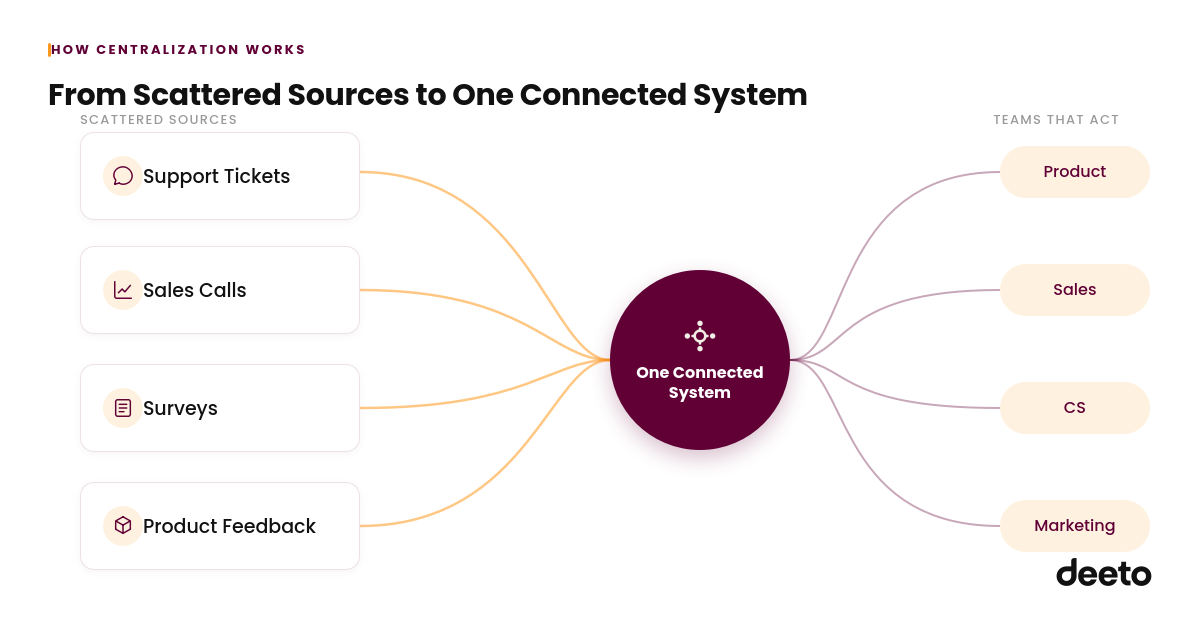
Deeto's platform is built around that same connective-layer idea: capture the signal once, organize it in one system of record, then get it to whichever team owns the decision, whether that's Listen surfacing a new theme, Learn keeping it searchable, or Activate, Analyze, and Orchestrate getting it into the workflows where sales, CS, product, and marketing actually work. That's what turns a folder of voice of customer interviews and survey exports into a shared system instead of a spreadsheet someone updates once a quarter.
In most companies, Customer Marketing (or whoever owns voice of customer) ends up closest to this system day to day, since they're already the ones pulling quotes for case studies, briefing sales on objections, and feeding product teams what customers are asking for. Customer Marketing teams that centralize feedback well treat it the same way revenue teams treat pipeline: reviewed on a set cadence, owned by someone specific, and too important to live in one person's inbox. Product benefits downstream once that system exists too. If you're mapping how centralized feedback should shape what gets built next, how to use customer feedback to build a product roadmap covers that next step.
Key Takeaways
- Centralizing customer feedback means routing input from every team and channel into one connected, searchable system, not just collecting more of it.
- Scattered feedback creates partial pictures of the customer and slows decisions, since no single team sees the whole pattern.
- A shared taxonomy has to come before shared tooling, or the data won't be comparable across teams.
- Routing rules and closed feedback loops are what separate a working system from a dashboard no one checks.
- A customer voice intelligence layer like Deeto's removes the manual synthesis work that keeps most feedback siloed in the first place.
FAQs
What does it mean to centralize customer feedback?
Centralizing customer feedback means collecting input from every source, support, sales, surveys, reviews, and in-product signals, into one connected system instead of leaving it scattered across separate tools. It gives every team access to the same searchable, tagged dataset rather than a partial view.
Why is scattered customer feedback a problem?
When feedback stays siloed by team, each function only sees part of the customer's story. Decisions get made on incomplete information, patterns take longer to surface, and by the time a risk or opportunity is visible, it's often too late to act on it efficiently.
What tools do I need to centralize customer feedback?
You need a system that ingests feedback from your existing tools, CRM, support desk, survey platform, and review sites, rather than one more standalone tool teams have to update manually. Platforms like Deeto are built specifically to connect those sources instead of replacing them, which is what makes adoption easier across teams.
How is centralizing feedback different from collecting more feedback?
Most companies already collect plenty of feedback. Centralizing it means adding the connective layer, shared taxonomy, routing, and searchability, that turns scattered comments into a dataset teams can actually query and act on.
Which team should own centralized customer feedback?
Ownership varies by company, but someone needs to be accountable for the system itself: maintaining taxonomy, monitoring routing rules, and reviewing patterns on a set cadence. Without a clear owner, even a well-built system tends to drift back into silos.
How often should teams review centralized feedback?
Monthly reviews catch emerging patterns while they're still small. Quarterly business reviews are useful for strategic decisions, but waiting a full quarter to look at feedback data means smaller trends, an early churn signal or a recurring feature request, can go unnoticed for months.
Conclusion
Centralizing customer feedback isn't about adding another tool to the stack. It's about giving every team access to the same customer story instead of a fragment of it. Start with a shared taxonomy, connect your existing sources instead of replacing them, and build routing rules that get insight to the team that owns the decision. The companies that do this well don't just react to customer feedback faster, they build products, campaigns, and renewal strategies on a foundation of what customers actually said, not what one team assumed. If you're ready to see what that looks like connected end to end, Deeto's platform brings Listen, Learn, Activate, Analyze, and Orchestrate together into one system built for exactly this.
🎉 Save your spot
Register for the event
Once your spot is secured, we’ll send your confirmation details.
Subscribe to our newsletter
Subscribe to receive the latest blog posts to your inbox every week.
By subscribing, you agree to our Privacy Policy
Subscribe to our newsletter
Get the latest news and updates from our team.
By subscribing, you agree to our Privacy Policy
Related posts

Call Intelligence Software That Spots Your Next Reference

What is call intelligence software? Learn how it scores every call automatically and surfaces advocacy-ready customers.

4 Ways To Leverage Social Proof In Marketing
What is social proof in marketing? Learn 4 ways to use reviews, stories, and advocacy to build buyer trust.

Customer Proof Marketing: How B2B Companies Build Trust with Buyers
What is customer proof marketing? Learn the proof types, frameworks, and software that build B2B buyer trust.