Customer Feedback Platforms Compared: 10 Tools for 2026



Tuesday, August 11, 2026


Customer Feedback Platforms Compared: 10 Tools for 2026


View the podcast on Youtube

Customer feedback shows up everywhere except where you need it: a support ticket here, an NPS response there, a Slack message from your CSM about something a customer said on a call last week. A customer feedback platform is software that collects, organizes, and analyzes that feedback from multiple channels so your team can spot patterns and act on them instead of chasing quotes across five different tools. This guide compares 10 platforms so you can find the right fit for your team's channels, scale, and goals.
What Is a Customer Feedback Platform?
A customer feedback platform is a tool that captures customer input from surveys, support tickets, reviews, calls, and in-app prompts, then organizes it so teams can find patterns and prioritize action. Most platforms handle some mix of three jobs. They collect feedback, analyze it for themes and sentiment, and route it to the people who can act on it.
There's a useful dividing line in this category: a tool that only gathers survey responses is a collection tool. A true feedback platform connects direct feedback, like surveys and reviews, with indirect signals like support tickets and calls, then turns both into something a team can act on.
Not every tool on this list clears that bar the same way. Some are built for survey collection, some for text analytics, and some for product feedback tracking. Knowing which job you need done first will save you from buying more tools than you need, or less.
Why Customer Feedback Platforms Matter
Companies that treat customer feedback as a system, not a folder of survey exports, grow faster. Forrester's 2024 US Customer Experience Index found that customer-obsessed organizations report 41% faster revenue growth, 49% faster profit growth, and 51% better customer retention than non-customer-obsessed organizations. The difference is whether anyone can find that feedback, connect it to an account, and act on it before the moment passes.
The cost of not doing this shows up on both sides of the business. Internally, product and CS teams waste hours searching Slack threads and ticket histories to answer a simple question: has a customer asked for this before? Externally, buyers are checking your credibility the same way. TrustRadius's 2026 B2B Buying Disconnect Report found that 74% of buyers use reviews to inform their purchase decisions, which means the feedback you collect, and how visibly you act on it, is doing double duty as your reputation.
These platforms exist to close the gap between hearing something and doing something about it.
Key Features to Look for in a Customer Feedback Platform
Before comparing tools, it helps to know what actually separates a strong platform from a survey tool with a dashboard bolted on.
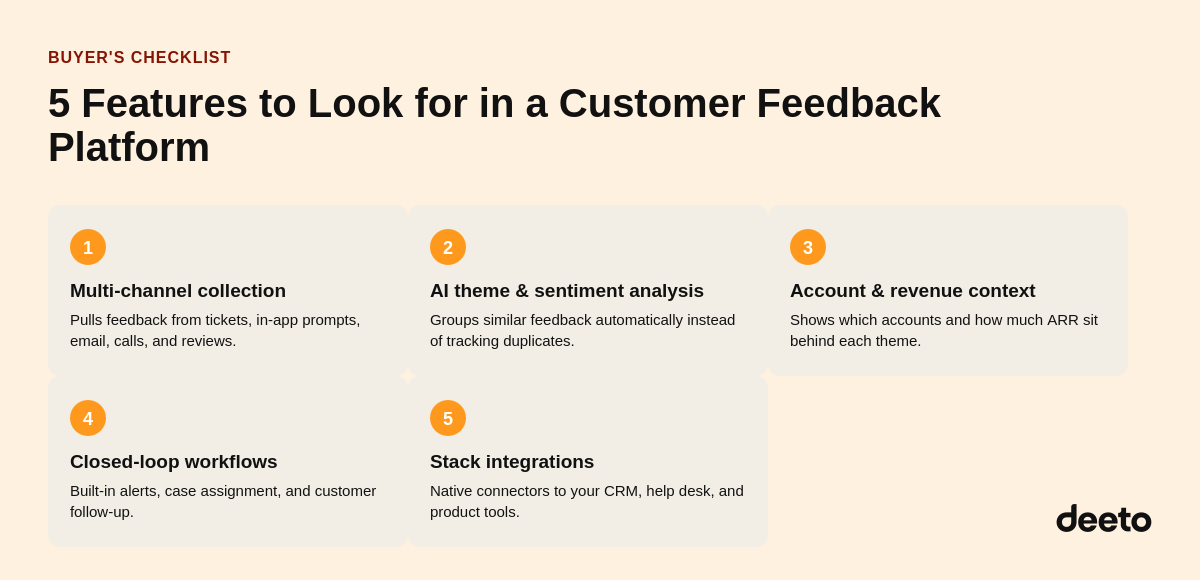
- Multi-channel collection. The platform should pull feedback from where customers already talk to you: support tickets, in-app prompts, email, calls, and reviews, not just a survey link.
- AI-driven theme and sentiment analysis. Look for a tool that groups similar feedback automatically. If three customers describe the same problem three different ways, the platform should recognize that as one theme, not three.
- Account and revenue context. A theme without context is a word cloud. The strongest platforms show which accounts, segments, or ARR sit behind a piece of feedback, so you can prioritize by business impact instead of volume alone.
- Closed-loop workflows. Feedback that never gets a response trains customers to stop giving it. Look for built-in alerts, case assignment, and a way to notify customers when you act on what they told you.
- Integrations with your existing stack. Feedback is only useful where decisions happen. Native connectors to your CRM, help desk, and product ticketing tools matter more than a long feature list.
10 Customer Feedback Platforms Compared
Here's how 10 established platforms stack up, organized by what each one does best.
1. Enterpret
Best for: Unifying feedback across channels with AI-driven analysis
Enterpret pulls feedback from more than 50 sources and uses an adaptive taxonomy that learns your product's language instead of requiring manual tagging. It suits teams that want continuous analysis tied to revenue, not a one-time report.
2. Chattermill
Best for: Enterprise CX teams with feedback already centralized
Chattermill applies AI sentiment and theme analysis to feedback from surveys, reviews, and support tickets. It's a strong fit for larger CX organizations that need deep text analytics more than collection.
3. Qualtrics
Best for: Large-scale, survey-led voice of customer programs
Qualtrics is the enterprise incumbent in structured survey methodology and program management. Its analysis leans heavily on survey data, which is a limitation for teams whose feedback mostly lives outside surveys.
4. Medallia
Best for: Multi-team CX orchestration at enterprise scale
Medallia combines survey, speech, and operational data across large, multi-brand programs. It carries real implementation weight, so it tends to suit teams with dedicated CX operations staff.
5. Zonka Feedback
Best for: Multi-channel survey collection
Zonka covers more feedback channels than most survey tools, including SMS, WhatsApp, in-app SDK, and offline kiosk surveys, with closed-loop task assignment built in. It's a collection-first tool, so pair it with a dedicated analytics layer if you're processing high volumes of open-ended feedback.
6. SurveySparrow
Best for: Automating feedback analysis for mid-market teams
SurveySparrow's AI tools surface loyalty drivers and sentiment from survey responses across email, WhatsApp, and web channels, with automated CSAT follow-ups built in.
7. Survicate
Best for: Website and in-product feedback programs
Survicate targets surveys at specific in-app or on-site moments and captures partial responses so incomplete feedback doesn't get lost. It measures NPS, CSAT, and CES out of the box.
8. Canny
Best for: Public feature request tracking
Canny gives customers a public board to submit and vote on feature requests, with a roadmap they can follow. It works well for community-driven products, but it runs separately from your support platform, so feedback that shows up in tickets or calls won't automatically land here.
9. Pylon
Best for: B2B support teams that want feedback tied to support conversations
Pylon's Product Intelligence captures feature requests directly from support tickets, Slack, and calls, then clusters similar requests and shows how much ARR sits behind each one. It's built for teams that want feedback analysis inside their support platform instead of as a separate workflow.
10. Thematic
Best for: Transparent, research-grade theme detection
Thematic specializes in text analytics with strong explainability. It shows how it derived each theme, which matters for research and insights teams that need to defend their findings, not just report them.
How to Choose the Right Customer Feedback Platform
The right platform depends on which job you're actually hiring it to do. If you need feedback collection first, start with a survey-led tool like Zonka, SurveySparrow, or Survicate. You can layer analytics on top once volume grows. If feedback is already scattered across tools, prioritize a unification and analysis platform like Enterpret or Chattermill that can ingest what you already have.
If your feedback lives mostly in support conversations, a support-embedded tool like Pylon keeps that context intact instead of asking your team to re-log everything into a separate system. If you're running a structured, enterprise-wide VoC program, Qualtrics or Medallia bring the program management muscle that smaller tools don't. If product feedback and feature voting is the priority, a dedicated board like Canny fits better than a general feedback platform.
Whatever you choose, the platform is only half the system. The other half is what happens after feedback is collected: who sees it, how it gets connected to a customer or account, and whether it ever turns into a decision.
Where a Customer Voice Intelligence Platform Fits In
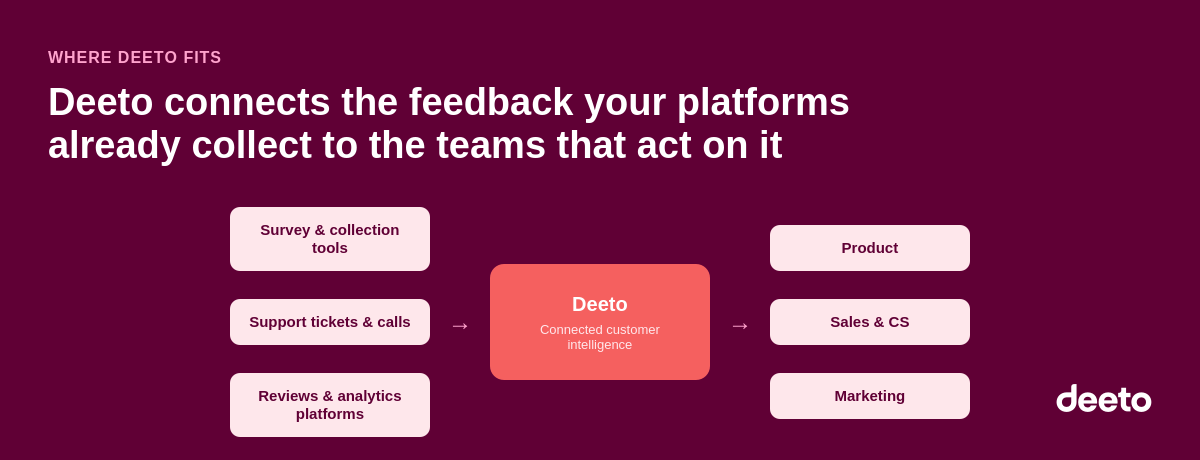
Most tools on this list are built to collect and analyze feedback. Deeto solves a different, related problem: what happens to that feedback once you've captured it.
Deeto is an AI-native customer orchestration platform that connects authentic customer voice to the people and workflows that act on it, across product, marketing, sales, and CS. It sits alongside your existing feedback or survey tool rather than replacing it, turning scattered customer signals into connected customer intelligence.
That distinction matters for teams that already collect plenty of feedback but struggle to do anything with it. If your product team is drowning in feature requests scattered across three tools, or your CS team can't tell whether customer sentiment is shifting until a renewal is already at risk, the gap usually isn't a lack of feedback tools. It's a lack of a system connecting what customers say to what the business does next.
Deeto doesn't compete with a survey platform or a text analytics tool. It completes them, by giving product teams and go-to-market teams a shared, continuously updated view of what customers are telling you, without anyone manually stitching together five different exports. Teams that connect feedback this way report up to a 25% improvement in prioritization accuracy once feedback stops living in silos.
Key Takeaways
- A customer feedback platform collects, organizes, and analyzes customer input so teams can act on patterns instead of chasing individual quotes.
- Companies that treat feedback as a system grow faster: Forrester found customer-obsessed companies report 41% faster revenue growth and 51% better customer retention than non-customer-obsessed companies.
- Look for multi-channel collection, AI-driven theme detection, account and revenue context, and closed-loop workflows before comparing feature lists.
- Survey-led tools like Zonka, SurveySparrow, and Survicate are built for collection. Analytics platforms like Enterpret, Chattermill, and Thematic are built for interpretation. Know which job you're solving for first.
- Collecting feedback and connecting it to action are two different problems. A customer voice intelligence layer addresses the second, once your collection and analytics tools have handled the first.
Conclusion
The problem isn't a shortage of customer feedback platforms. It's picking the one built for the job you actually have, whether that's collection, analysis, product feedback tracking, or connecting feedback to revenue and action across your business. Start with what's broken today. If feedback isn't getting collected, fix that first. If it's collected but nobody acts on it, that's a different problem, and one worth solving before you buy another survey tool.
Want to see how Deeto connects customer feedback to decisions across your team? Book a demo to see it in action.
FAQs
What is a customer feedback platform?
A customer feedback platform is software that collects customer input from surveys, support tickets, reviews, and other channels, then organizes and analyzes it so teams can spot patterns and prioritize what to fix or build next. The strongest platforms also connect that feedback to specific accounts and revenue.
What's the difference between a feedback collection tool and a feedback analytics platform?
Collection tools, like survey software, are built to gather responses. Analytics platforms interpret what's already been collected, surfacing themes and sentiment from open-ended feedback. Some platforms do both, but most specialize in one job or the other.
How much do customer feedback platforms cost?
Pricing varies widely based on features and scale. Survey-led tools often start under $50 per month, while enterprise analytics and VoC platforms typically require custom pricing based on feedback volume, seats, and integrations.
Do I still need a survey tool if I use a feedback analytics platform?
Usually yes. Surveys capture feedback from customers who choose to respond, while analytics platforms interpret feedback from all channels, including support tickets and calls. Most teams pair a collection tool with an analytics or intelligence layer rather than replacing one with the other.
How is a customer feedback platform different from a customer voice intelligence platform?
A customer feedback platform focuses on collecting and analyzing input. A customer voice intelligence platform, like Deeto, goes further by connecting that feedback to the people, workflows, and revenue context needed to act on it across product, sales, and CS.
What should I look for first when comparing customer feedback platforms?
Start with the channels where customers actually give feedback today. A platform that doesn't ingest from those channels natively will leave gaps no dashboard can fix. From there, prioritize AI-driven theme detection and closed-loop workflows over a long feature list.
🎉 Save your spot
Register for the event
Once your spot is secured, we’ll send your confirmation details.
Subscribe to our newsletter
Subscribe to receive the latest blog posts to your inbox every week.
By subscribing, you agree to our Privacy Policy
Subscribe to our newsletter
Get the latest news and updates from our team.
By subscribing, you agree to our Privacy Policy
Related posts

Customer Proof Marketing: How B2B Companies Build Trust with Buyers

What is customer proof marketing? Learn the proof types, frameworks, and software that build B2B buyer trust.

How to Build a Customer Churn Model: A Guide for Businesses
What is a customer churn model? Learn how to build one, spot churn early, and win back at-risk customers.

How to Adapt Business Strategy to Changing Customer Behavior
What does it take to adapt business strategy to changing customer behavior? Learn the signals, the framework, and the ne