7 Best AI Customer Insight Tools for B2B Teams in 2026



Tuesday, August 25, 2026


7 Best AI Customer Insight Tools for B2B Teams in 2026


View the podcast on Youtube

B2B teams rarely lack customer feedback. What they lack is anyone able to act on it before the moment passes. Survey responses, support tickets, and sales calls pile up faster than any analyst can tag by hand, and insight ends up trapped in a dashboard instead of a rep's hands. AI customer insight tools exist to close that gap: software platforms that use machine learning and natural language processing to analyze customer feedback, conversations, and behavioral data at scale, surfacing themes, sentiment, and patterns a person could never catch manually. This guide breaks down the 7 best options in 2026, what each one is actually built for, and how to think about AI customer intelligence as a category before you buy.

What Are AI Customer Insight Tools
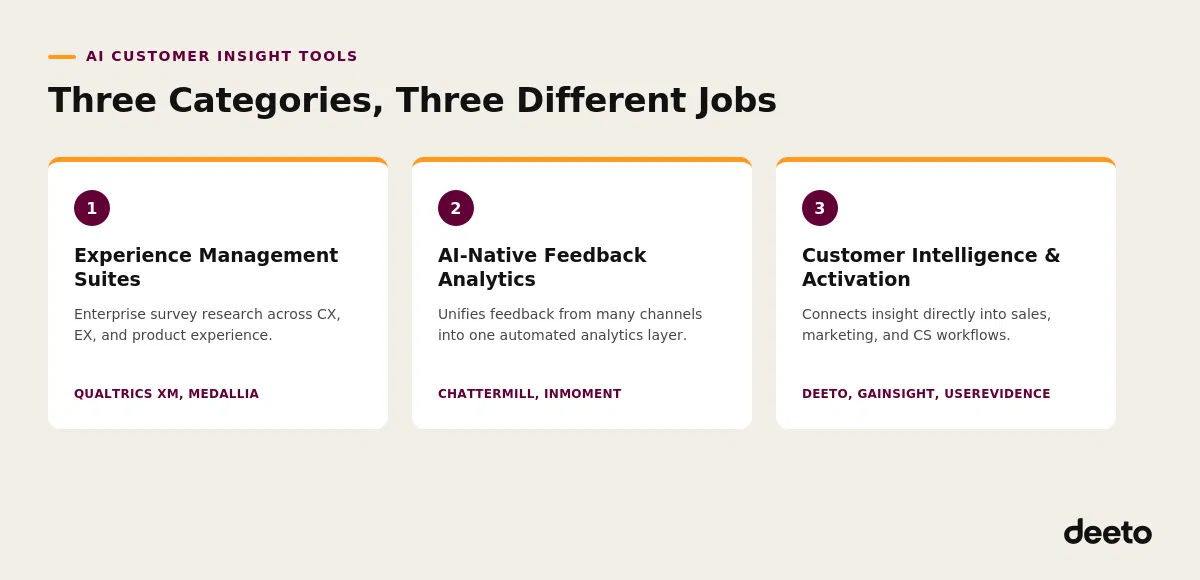
AI customer insight tools apply AI models to unstructured customer data, such as call transcripts, survey responses, support tickets, and reviews, and extract structured signal from them. Instead of an analyst manually tagging themes across thousands of responses, the platform identifies patterns, sentiment shifts, and emerging issues on its own. Most tools in this category fall into one of three groups: experience management suites built for enterprise-scale survey programs, AI-native feedback analytics platforms built for unifying multi-channel data, and customer intelligence platforms built to connect insight directly into GTM and product action.
According to McKinsey's most recent State of AI survey, 88% of organizations now report regularly using AI, up from 78% the year before. But the same survey found something more telling: most organizations still haven't embedded AI deeply enough into their workflows to see material business impact. That's the dashboard problem in miniature. The AI is running and the summary exists. It just never makes it to the rep who needs it in the moment.
What to Look for in an AI Customer Intelligence Platform
Before comparing tools, it helps to know what actually separates a strong AI customer intelligence platform from a dashboard with a chatbot bolted on. Look for these five things:
- Multi-channel coverage. The platform should ingest feedback from surveys, support tickets, sales calls, reviews, and in-product signals, not just one channel.
- AI depth, not just AI labeling. Theme detection and sentiment analysis should adapt to your data, not force you into a fixed taxonomy.
- Activation, not just analysis. A platform that surfaces insight but leaves it in a dashboard doesn't close the loop. Look for tools that push insight into CRM, sales enablement, and marketing workflows.
- Verified, sourced data. AI summaries are only as trustworthy as the underlying feedback. Platforms that show their sourcing build more internal trust than ones that just output a confident-sounding summary.
- Integration depth. Your CX, product, and revenue teams already live in Salesforce, HubSpot, Slack, and your support desk. A platform that doesn't connect to those tools creates another silo instead of closing one.
The 7 Best AI Customer Insight Tools in 2026
At a Glance: 7 AI Customer Insight Tools Compared
1. Deeto
Best for: Teams that need customer intelligence connected directly to sales, marketing, and CS workflows, not just a research repository.
Deeto is an AI-native voice of customer platform built around a simple idea: authentic customer voice should be the input that drives every decision, not a side project that lives in a spreadsheet. Deeto is organized around five connected modules. Listen captures authentic customer voice continuously through interviews, surveys, question sets, and in-product microfeedback. Learn stores and organizes that intelligence in one system of record tying companies, people, and assets together. Activate delivers the right insight or proof point to the right person at the right moment, in sales, marketing, or CS workflows. Analyze identifies patterns, sentiment, and trends across everything captured. Orchestrate runs the automations that keep the whole system connected.
What separates Deeto from a feedback analytics platform is that insight doesn't stop at a dashboard. A sales rep working a competitive deal gets the right customer proof point surfaced automatically. A product marketer building a launch gets grounded messaging pulled from real customer language instead of internal assumptions. Teams using Deeto report 20 to 30% faster sales cycles and 15 to 25% higher win rates through contextual, always-current customer proof.
Best fit: Customer marketing, product marketing, and revenue teams that want customer intelligence to actively move deals and campaigns, not just inform a quarterly report.
2. Qualtrics XM
Best for: Large enterprises already running a broad experience management program across customer, employee, and product experience.
Qualtrics XM is one of the most established platforms in experience management, built around survey research and longitudinal tracking of customer sentiment. It's a strong fit for organizations that need a single system covering CX, employee experience, and product experience together, and that have the internal team to run a self-serve program with professional services layered on as complexity increases.
Watch out for: Qualtrics is built for teams with dedicated research and analytics headcount. Smaller teams often find the platform's breadth comes with a steep setup curve.
3. Medallia
Best for: Global enterprises capturing feedback across physical and digital touchpoints at massive scale.
Medallia is an omnichannel experience management platform designed to capture signals from digital interactions, in-store experiences, contact centers, and surveys in one place. Its Athena AI engine applies natural language processing and predictive modeling to connect customer sentiment with operational and financial outcomes, helping enterprise teams spot churn risk and emerging issues across business units.
Watch out for: Medallia's strength is breadth, but that breadth requires a more extensive setup and ongoing management. It's built for organizations with a mature CX function, not a lean team trying to move fast.
4. Gainsight
Best for: Customer success teams anchoring a program around account health and renewals.
Gainsight is a customer success platform that aggregates product usage, engagement signals, and feedback into account-level health scores. It approaches customer intelligence from a retention and expansion angle rather than a feedback-analysis angle, making it a natural fit for CS-led organizations that need early visibility into risk and growth signals tied to specific accounts.
Watch out for: Gainsight is built around the CS motion specifically. Teams looking for cross-functional insight spanning product, marketing, and sales will likely need to pair it with another tool.
5. Chattermill
Best for: Enterprise CX teams that need to unify feedback from many channels into one AI-native analytics layer.
Chattermill is an AI-native feedback analytics platform built to ingest and normalize data from over 30 sources, including surveys, support tickets, reviews, social, and voice, into a single view. Its Lyra AI engine uses aspect-based sentiment analysis to detect themes and emerging issues automatically, without manual tagging, and maps sentiment shifts directly to metrics like NPS, CSAT, and revenue impact.
Watch out for: Chattermill is built for feedback-first CX teams. It's a strong analytics layer, but organizations also running sales or marketing activation typically pair it with a second platform to close that loop.
6. InMoment
Best for: CX teams that want strong analytics paired with hands-on program guidance.
InMoment combines a self-serve AI analytics platform with one of the more consultative professional services teams in the category. It's a strong option for teams that want more than software, specifically guidance on program design, insight interpretation, and turning analysis into operational action, delivered through role-based dashboards and frontline tracking.
Watch out for: The consultative layer that makes InMoment strong for guided programs also means it leans toward CX-led use cases rather than broader customer intelligence spanning product and revenue teams.
7. UserEvidence
Best for: Teams focused specifically on collecting and packaging verified customer proof for sales deals.
UserEvidence is a customer evidence platform built around collecting testimonials, ROI stats, and verified proof assets, then matching the right customer reference to the right deal using AI. It's a focused tool for reference management and evidence collection, with AI-assisted matching that reads survey responses and engagement history to recommend the best-fit customer for a given ask.
Watch out for: UserEvidence is purpose-built for evidence and reference workflows specifically. Teams that need that proof connected to broader listening, analysis, and orchestration across the full customer lifecycle typically need a platform built for that wider scope.
How to Choose the Right AI Customer Insight Tool for Your Team
The right choice depends less on which tool has the most AI features and more on where the insight needs to go once you have it.
If your primary need is enterprise-scale survey research across CX, employee, and product experience, an experience management suite like Qualtrics or Medallia makes sense. If you're building a CS-led retention motion around account health, Gainsight is built for that. If your bottleneck is unifying feedback from dozens of channels into one analytics layer, Chattermill or InMoment are strong fits. If you specifically need customer proof for sales deals, UserEvidence covers that slice well.
If the real problem is that customer intelligence lives in five different tools and never makes it into a rep's hands during a live deal, that's a different problem. The problem isn't collecting customer feedback, but connecting those insights into decisions. That's the gap Deeto is built to close, by treating authentic customer voice as the input, intelligence and activation as the operating system, and orchestration as the outcome.
Key Takeaways
- AI customer insight tools fall into three broad categories: experience management suites, AI-native feedback analytics platforms, and customer intelligence platforms built for activation.
- Most organizations already generate AI-powered insight. The gap is getting that insight into the hands of sales, marketing, and CS teams fast enough to act on it.
- Qualtrics, Medallia, Gainsight, Chattermill, and InMoment each serve a specific lane, survey research, omnichannel CX, customer success, feedback analytics, or guided CX programs.
- UserEvidence focuses specifically on customer evidence and reference management for sales.
- Deeto is built to connect authentic customer voice to action across sales, marketing, and CS in one system, rather than leaving insight in a standalone dashboard.
FAQs
What is an AI customer insight tool?
An AI customer insight tool is software that uses machine learning and natural language processing to analyze customer feedback, conversations, and behavioral data, surfacing themes, sentiment, and patterns automatically instead of requiring manual analysis. The best tools go a step further by connecting those insights to workflows in sales, marketing, and customer success.
What is AI customer intelligence?
AI customer intelligence is the practice of using AI to turn raw customer signals, like survey responses, support tickets, and sales call transcripts, into structured, connected intelligence that guides business decisions. It differs from basic feedback analysis by tying insight to specific accounts, deals, or product decisions rather than producing a static report.
What's the difference between a feedback analytics platform and a voice of the customer platform?
A feedback analytics platform focuses on analyzing customer data and surfacing themes and sentiment. A Voice of Customer platform like Deeto goes further, taking that intelligence and actively delivering it to the right person, in the right workflow, at the right moment, whether that's a sales rep in a live deal or a product marketer building a launch.
Do I need more than one AI customer insight tool?
Many organizations end up running two or three tools that serve different lanes, for example an experience management suite for enterprise survey programs alongside a customer intelligence platform for activation. The right stack depends on whether your gap is in data collection, analysis, or getting insight into action.
How is Deeto different from customer evidence platforms like UserEvidence?
Customer evidence platforms focus specifically on collecting and packaging testimonials and reference-ready proof for sales. Deeto covers that use case as part of a broader system that also listens, analyzes, and activates customer intelligence across marketing and customer success, not sales alone.
Conclusion
There's no single best AI customer insight tool for every team. An enterprise CX org running a global survey program has different needs than a customer marketing team trying to get proof points in front of reps during live deals. What matters is matching the tool to where your actual bottleneck sits: collection, analysis, or activation.
For teams whose bottleneck is turning customer voice into decisions across the whole organization, not just one team's dashboard, Deeto's customer intelligence platform is built to close that gap. Book a demo to see it against your own use case.
🎉 Save your spot
Register for the event
Once your spot is secured, we’ll send your confirmation details.
Subscribe to our newsletter
Subscribe to receive the latest blog posts to your inbox every week.
By subscribing, you agree to our Privacy Policy
Subscribe to our newsletter
Get the latest news and updates from our team.
By subscribing, you agree to our Privacy Policy
Related posts

Call Intelligence Software That Spots Your Next Reference

What is call intelligence software? Learn how it scores every call automatically and surfaces advocacy-ready customers.

4 Ways To Leverage Social Proof In Marketing
What is social proof in marketing? Learn 4 ways to use reviews, stories, and advocacy to build buyer trust.

Customer Proof Marketing: How B2B Companies Build Trust with Buyers
What is customer proof marketing? Learn the proof types, frameworks, and software that build B2B buyer trust.