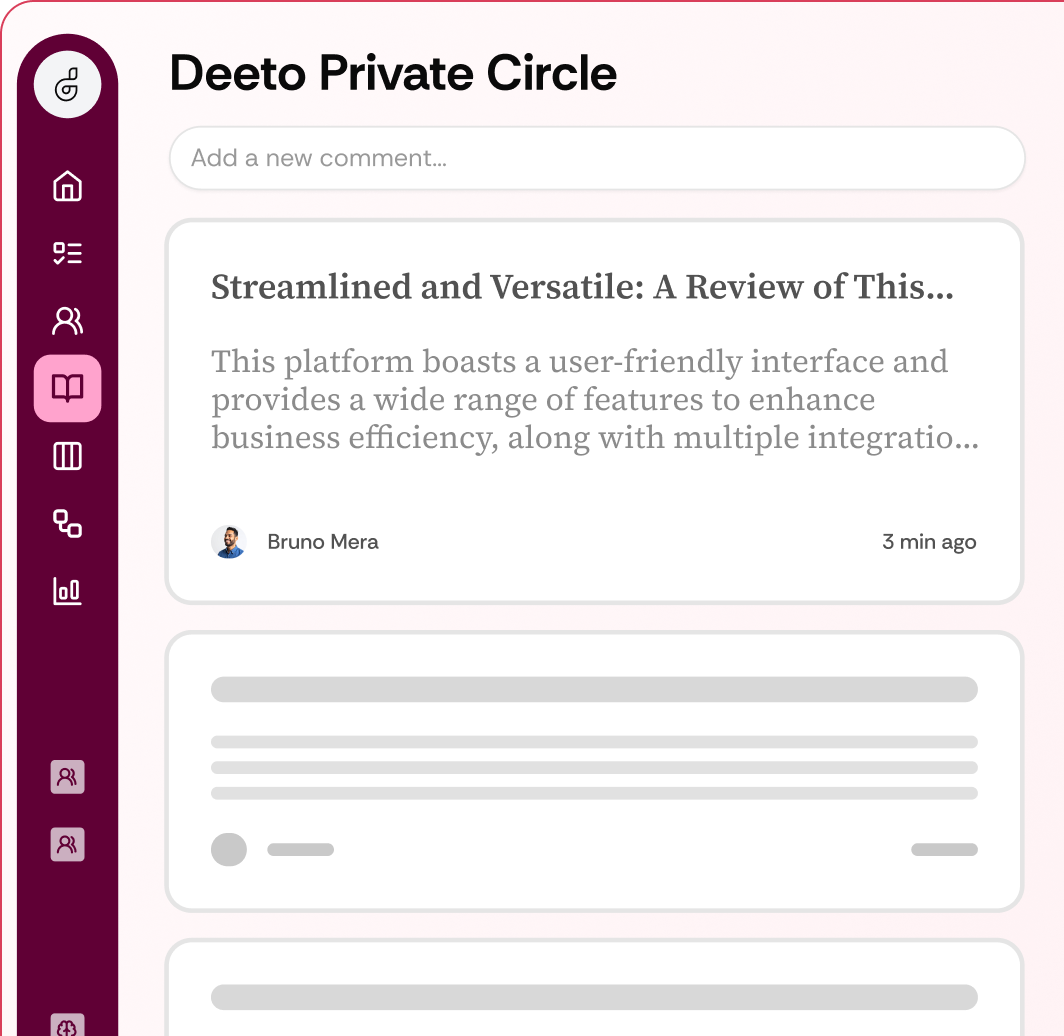
A resource and community space for modern marketers, sellers, and builders using customer voice to grow — together.
This hub is built for anyone who wants to do more with the voices of their customers. Whether you're scaling advocacy, building trust with proof, or rethinking how to go to market — you're in the right place.
How-to guides and playbooks for building with customer voice
Campaign-ready templates and swipe files
Benchmark reports and reference best practices
Event recordings, expert sessions, and community spotlights
Ask questions. Share ideas. Trade wins. This is your space.
You don’t have to figure this out alone. The Deeto community connects you with other leaders using customer voice to build better GTM motions, faster-growing brands, and smarter strategies. If you are interested in joining when it launches, sign up below.
Automate advocacy management workflows
Dynamically generate customer stories and social proof
Eliminate manual reference management
Track and report advocacy impact on revenue
Discover practical guides, templates, and tools to help your team close more deals, faster.
What drives your sales? You might be tempted to say "our marketing," "our tech stack," or "our all-star sales team."
And you'd be 100% right. But you're missing one crucial element: your customers.
91% of B2B buyers say they rely on word-of-mouth when making purchase decisions (though, really, I doubt the other 9% are out here making major investments in enterprise software without at least checking a few reviews).
No matter what, hearing how great your product is from someone your prospect can relate to will always have more of an impact than telling them yourself through ads, cold email, and a product demo.
Advocacy can become a powerful force in your sales strategy when harnessed correctly, especially as part of a program to accelerate sales.
In this day and age, whether or not you convert a healthy number of customers is directly tied to your ability to leverage your current customer base at every stage of the sales process.
The biggest problem companies run into when scaling their customer advocacy program is taking a one-size-fits-all approach.
The truth is, like every prospect in your pipeline, every advocate is different, and a successful customer marketing strategy plays to each of their strengths.
All these, plus a particular advocate's communication/contribution preferences and their role/level of seniority within their company, change how they can support your sales process.
To use your customers to their fullest extent, you have to think, "How can I use my customers' experiences to connect with my prospects in a way they'll trust and relate to?"
Then, you have to gather the right mix of content to address your customers at every stage of the sales cycle.
G2's 2023 Software Buyer Behavior Report found that ~84% of today's decision-makers use third-party review sites as part of their buying journey. And, according to research from Gartner, they collectively hold roughly 1.4x the weight of anything you'd publish yourself.
They're authentic, transparent, and segmented based on what the buyer cares about as opposed to what you want them to see.
The good news: This is something you can do right now.
Start with highly engaged customers who have been with you awhile and have a lot of good things to say. Identify them based on product use, payment/order history, and NPS/customer satisfaction scores.
Send them an automated email inviting them to leave a review on G2, Capterra, or TrustRadius (you can set this up by making a free account). Include a small incentive, like a $20 gift card.
Deeto’s new G2 integration makes this even more frictionless for your customers. You can invite them to leave a review within the platform. They don’t have to switch screens or spend 15 minutes setting it up.
Your buyers are 57% to 70% through the decision-making process by the time they talk to your sales team, and most of their research is done online. So, the impact of this contribution spans several stages of the sales funnel — from Awareness to the final decision.
Since most of the sales process happens without intervention from sales, you need adequate web content to guide decision-making.
Incorporating ratings, testimonials, quotes, and stats into your landing pages, product/service pages, and articles will definitely boost your web conversions. But personalized UGC takes it a step further.
Use a tool like Deeto to efficiently create customer content, then display your reviews, user stories, and video testimonials live on mobile and desktop.

Depending on who is visiting the page, which page they visit, and their previous site behavior, they'll see content that's most relevant to them.
If your sales team has problems with low open and click-through rates, it's probably because they're sending generic emails and InMails.
Sending out messages by the 1,000s might have worked in the '90s. These days, being in a decision-making capacity means your inbox is flooded with stuff like this:

No, the email didn't find me well. delete
Deeto's smart-matching algorithm shows your sales team which of your current customers have similar use cases and jobs, plus all the content they've left in the system.
From there, reps can personalize their conversations at every stage of the funnel — Awareness-stage prospects, lead nurturing for mid-stage buyers, and consultative sales late in the game.
Once you deliver a personalized sales demo, your prospect's buying group will have plenty more questions.
Allowing later-stage prospects to chat live with current customers will give them the real story. It answers their questions in a way your sales team can't.
The same smart-matching algos used to personalize sales outreach also connect prospects and references, so your sales reps don't have to play Matchmaker when setting these conversations up.
If you think the sales cycle ends when someone signs the dotted line, you're wrong. Especially if you use a recurring revenue model (SaaS, I"m talking to you), customer engagement is the name of the game.
Your advocacy program is the perfect way to (a) keep happy customers engaged with your product and (b) turn your customer base into a lead generation tool.
Over the long term, that's what really increases sales velocity and CLV.
If you're reading this and thinking, "I can't manage this all in a spreadsheet," you'd be 100% right. Software really is the enabler, here. Run your whole customer advocacy program with Deeto.


Accelerate the sales cycle using your current customers with these 5 proven, efficient strategies.
If you're savvy with social media, you already know how UGC works. If you prefer to stay off the grid, the concept is simple:
The whole reason user-generated content is so effective is because...well...it's user-generated.
It's authentic.
And, in many cases, it's organic.
When it comes to using UGC as a sales and marketing tool, though, it's always one of two issues:
I've already written extensively on turning your customers into brand advocates and what's holding your customer marketing program back from scale.
So, let's dive into how you can take a personalized approach to UGC (and use it to connect with prospects in your pipeline).
In the context of UGC, "personalization" means taking the time to understand your buyers and their experiences, then serving them customer-generated content they can actually relate to.
The problem with most UGC is it takes the "me, me, me" approach. It's all about the brand and its products or services (because, well, that's what people are posting about).
Spoiler alert: Your prospects don't care what you did for someone else unless it's directly relevant to their own needs. Shifting the focus from you to your customer is Sales 101.
Personalized UGC takes into account who is actually consuming the content...
...then curating and sharing content that specifically addresses those questions.
Initially, they'll have one or two things in mind that prompted them to reach out to you or respond to your outreach. This is normally centered around a problem they have or a goal they want to achieve.
Things like:
As they move through the buyer's journey, though, the shift will focus on questions like:
While user-generated content works at every stage of the buyer's journey, taking a personalized approach means sharing content that answers the questions and concerns your prospect currently has.
In early stages, that could be as simple as a review or testimonial ("We 5X'ed our web engagement.").
For later stages, it's more about addressing specific objections ("We were worried about implementation, but it was surprisingly painless.").
According to research from Gartner, the typical B2B buying decision requires six to 10 decision-makers.
You're dealing with:
While a technical decision-maker would probably care about how your platform integrates with their existing systems, execs want to understand $$$ in vs. $$$ out.
Legal/procurement wants to know about data security, and your end-users just want something that's easy to use.
Getting social proof to drive real results as a sales enablement tool ultimately boils down to those two factors:
If you're not taking a personalized approach to how you highlight customer experiences, you run the risk of wasting your prospects' (and customers') time.
In addition to losing a qualified lead, this can also undermine your customer advocacy program altogether — fewer customers will want to participate if their contributions aren't used in an impactful way.
Companies that personalize the B2B buying process see an average of ~1.4X revenue growth.
Nearly all (86%) of B2B buyers look at social proof before investing in new products. They're also ~70% through the buying process by the time they talk to your sales team.
So, your ability to source and distribute customer-generated content across your marketing and sales collateral in a timely and relevant way is by far the biggest determining factor in whether you'll get a return on your content investment.
Really, there are plenty of ways to incorporate UGC into the sales cycle. It all comes down to the tools and processes you use to accomplish that.
Start by auditing your sales framework and UGC assets. Are your sales reps asking questions during qualification that uncover pain points, buying group roles, and the prospect's overall goals? Are you collecting a broad range of customer stories and feedback that speak to different use cases, pain points, and types of buyers?
From there, look for a customer advocacy platform that does the heavy lifting for you with prospect-reference smart-matching, dynamic website content, and customizable content sharing.
While you're at it, check ours out.

Discover how to use UGC effectively to build trust, personalize outreach, and close more B2B deals faster.
You know the saying, "Easy come, easy go"? That's paid ads in a nutshell.
Let's preface this by saying there are clear use cases for PPC, PR, and other paid programs. And, of course, organic marketing isn't "free" — it'll still cost you time and resources.
But for the long-term growth and success of your business, organic marketing should be your primary focus.
Organic marketing is the art of driving traffic, leads, and sales without paying for ads. It's a long-term marketing strategy that focuses on building strong relationships with your current and potential customers through valuable, relevant content and customer engagement tactics.
Examples of organic marketing include:
Although organic marketing comes in all different flavors, the core theme is the same: you're investing time and effort into building relationships with your audience, rather than just throwing money to attract them.
Across the board, your cost per lead (CPL) is as much as half when you use organic marketing compared to paid campaigns.

In B2B SaaS, for example, the average paid lead costs $310.
The average organic lead? $165.
By extension, your CAC is also significantly lower. But there are other factors that contribute to a lower CAC throughout the sales cycle:
So, the residual impacts of your organic marketing efforts are a shorter sales cycle and a higher conversion rate — both of which reduce the overall cost of acquiring a customer.
The main benefit to organic marketing is that it's a long-term strategy.
Yes, you won't see immediate results like you would with paid ads. But organically generated traffic and leads are more reliable and sustainable over time.
Once you've established a solid organic marketing foundation, your efforts will continue to drive results without the need for constant investment.
B2B and B2C buyers alike use the internet to research and make purchase decisions. And they're becoming increasingly savvy at ignoring or blocking out paid ads.
In fact, just 8% of buyers see an ad and automatically think its claims are true.
Compared to the information they find organically on Google or through other people, those ads don't stand a chance when it comes to making an actual buying decision.
When you see an ad like this…

…it might grab your attention. But it sounds over the top.
But when you find reviews on their website or organic search?

You tell us what’s more believable.
People like to buy from companies they like and trust.
That's why 89% of people end up buying from a company they follow on social media. And it's why 92% of buyers are hesitant to try a product with no reviews or testimonials.
Organic marketing allows you to showcase your brand's personality, build trust with your audience, and form a community around your product.
For example, by integrating UGC into your sales cycle, you're doing more than just making your brand more trustworthy.

Customers who see their content repurposed on your feed will automatically feel more connected to your brand. And others who see it will know right away that you're the type of company that values its customers.
Plus, they'll get to see how others use your product.
Arguably the most valuable benefit of organic marketing is the fact that, once you've built a strong foundation, it continues to work for you even when you're not actively putting in effort.
The social media following, search engine presence, and customer relationships you build stick with you forever.
Of course, it isn’t set-it-and-forget-it. Assuming you pursue organic marketing with consistency, you'll rely on paid media less and less as time goes on. When you launch new products and features, you can bring them to market right away.
And your reputation becomes your best salesperson.

You know the saying, "Easy come, easy go"? That's paid ads in a nutshell.
Picture this: Everyone's buzzing about your product. And you didn't have to give up an arm and a leg to get their attention.
They're telling their friends, "You have to make the switch."
They're writing great reviews.
And your P&L is looking good.
Word-of-mouth marketing = social proof, a.k.a. the Holy Grail of brand validation. And as a business, that's exactly what you're after.
In simple terms, word-of-mouth marketing is the passing of information about a company's products or services from one person to another. Any time someone mentions your product to someone else (in-person or over the web), that's word-of-mouth marketing.
Here are a few examples:
If you've ever tried a product or service, then left a review or told a friend about it, you've participated in precisely what we're talking about.
When you hear about a product from a friend, you're more likely to trust it.
That's because word-of-mouth comes with the validation of someone else's experience. And people trust experiences over marketing campaigns and sales pitches.
86% of B2B buyers say word-of-mouth is the most influential factor when they make buying decisions. The vast majority don't trust ads anymore. And, according to data from Drip, less than one-third consider sales reps to be "trustworthy."
By engaging your customers on social media, integrating UGC into your sales cycle, and garnering social proof with intention, you're setting yourself up nicely for winning over potential customers.
When customers find it easier to trust you, four things happen:
In the last 5 years, the average CAC across all industries has increased 60%. When it's easier for you to attract customers and close deals, it costs considerably fewer resources to land them. So, by focusing heavily on word-of-mouth, you're looking at a healthier P&L.
It isn't just about making sure your brand is talked about in the right way. It's about putting strategies in place to help those conversations naturally occur. At scale.
Here's a look at 3 ways word-of-mouth is changing in 2025 (and how you can adapt):
User-generated content (UGC) is content your own customers (or users) create. Think reviews, testimonials, and user stories.
It's one of the best forms of word-of-mouth marketing because you can use it in your own sales and marketing efforts (with customers' permission, of course).
To adapt, make it easy for customers to create and share user-generated content. Encourage them to do so by offering incentives and creating a community for them to share their experiences.
In the modern B2B sales landscape, you're dealing with several decision-makers. And each prospect in your pipeline will have different pain points and challenges.
So, you can't have just any testimonial or review. You need a diverse range of social proof that caters to different roles and pain points.
When you're asking your customers for reviews and testimonials, encourage them to mention specific products, features, and benefits. That way, you can use them on corresponding landing pages, and your sales team can share them with the prospects they'll actually have an impact on.
Putting intention behind word-of-mouth marketing means building a customer advocacy program. And when you do that, you'll realize your customers are all comfortable with different forms of contributing.
Some prefer to write reviews and testimonials. Others will be happy to jump on a reference call with a prospect.
To get the most out of every customer's experience, you have to play to their communication preferences.
The essence here is personalization. If you feel like doing it 100% manually, you can. But a customer advocacy portal (where customers can choose how they'd like to contribute, set their availability, see the results their contributions lead to, and get rewarded when they do) definitely simplifies it.

Unlock the power of word-of-mouth marketing to build trust, grow your brand, and drive better conversions.
When it's time to make a purchase decision, nobody on Earth is more influential than someone who's been in your shoes.
Paid ads and company-sourced content get prospects in the door. But customers won't sign the dotted line without knowing for sure that others have seen success.
Voices championing your brand do more for your sales and marketing than any other asset. 92% of B2B buyers are likelier to make a purchase when they see a positive review, and social proof can increase your conversion rate by 270%.
Companies know all about the value of customer reviews, referrals, and success stories. That's why they invest in customer advocacy programs.
"Customer advocacy" refers to a customer voluntarily endorsing your brand or its products. A customer advocacy program is an ongoing, intentional effort to encourage this endorsement through reviews and testimonials, or by participating in marketing activities like case studies and customer referral calls.
Creating a successful customer advocacy program means...
...with the ultimate goal of demonstrating your credibility, driving more sales, and increasing customer loyalty.
There are multiple ways satisfied customers can become rockstar brand ambassadors.
Your customer advocates come in all shapes and sizes.
Some will have no problem leaving a review on G2 Crowd or sending you a quick written testimonial. Others are happy to take a hands-on approach and hop on a reference call alongside a sales rep.
The core focus of your customer advocacy strategy should be to play to each customer's strengths and interests.
Your customer advocacy efforts are like every other marketing initiative. To get the most out of this, you have to clearly define...
That way, you can encourage feedback that reinforces your value prop, feels relatable to prospects, and is useful to your overall marketing strategy.
Then, tie it all to KPIs you want to improve — web traffic, conversions, retention, sales cycle time, inbound lead gen.
For whatever reason, tools seem to be an afterthought for most companies. But, out of all the reasons you can't scale your customer marketing program, software is the solution to pretty much every one.
If you want to turn loyal customers into brand advocates, start by thinking about how they'll interact with your brand and the tools you use to enhance those interactions.
Look for a tool that:
Otherwise, you'll get one or two pieces of customer feedback. But you'll struggle to do it again, and again, and again.
Skip the investment now, and you'll end up backtracking later.
You want to avoid turning your brand-advocate relationships into transactional ones. When you launch your customer advocacy initiatives, start with existing customers who:
Once you've narrowed it down, figure out what motivates these candidates to speak up.
Forrester analyzed dozens of successful advocacy programs and found four common types of advocates:
To create a mutually beneficial relationship between you and your customers, you need to identify which type of person they are. Then, you have to channel their motivations to make their participation fulfilling.
For example, a Collaborator might think a full-fledged case study is the coolest idea in the world (so they'd respond in a timely manner, and it'd actually get done). Meanwhile, Educators are your most likely candidates for reference calls.
This could be something as simple as:
"Leave us a review on G2 Crowd. When you do, we'll give you $20 off your next month."
But...think bigger.
With a customer advocacy platform, you can send a simple invitation email to your most loyal customers. They can onboard themselves through a series of questions, set their preferences, and give their first customer feedback within a few minutes.
Like I pointed out above, there are several different types of advocates. They'll all have different communication styles and preferences (based on their own motivations).
Although each loyal customer will have intrinsic motivators, you still have to make things interesting and rewarding for them.
Assign a value to each advocacy activity that's proportional to the customer's input.
On their end, they should be able to see their progress towards different rewards. On yours, you'll see which customers have contributed what.
Once you've developed a scalable system for gathering customer feedback and UGC, take your goals from Step 1. Then, find out how you can use what you've gathered to achieve them.
Give your sales and marketing team access to your customers' insights, so they can incorporate them into their content, cold outreach, and sales conversations.
Customer loyalty programs should have some overlap with your advocacy activities. A weekly newsletter and occasional webinar for your most engaged customers can keep them in the loop, while also giving them a sense of exclusivity.
This is where you can talk about new product features, upcoming events and conferences you'll be attending, and company news. You could use these channels to invite them to beta test new features, too.
And, of course, use these messages to shout out your most active and loyal customers and reinforce their value.
Customer satisfaction is great. It's even better when you know what to do with it. With Deeto, all your advocates are in one place, for your sales and marketing teams to turn into true brand ambassadors. See how it works.

When it's time to make a purchase decision, nobody on Earth is more influential than someone who's been in your shoes.
Your customers want to help you, they just don't know how. Or maybe, the prospect of doing so isn't compelling enough.
Building a successful customer marketing program is simple. But there's a big difference between "simple" and "easy."
If you're trying to incorporate customer advocacy into your sales activities and marketing collateral but you aren't seeing the results you want, maybe it's time to revisit your approach.
Where should you start looking, though?
From what we've seen, these are the four main problems getting in the way of a successful advocacy program:
If you agreed to help your friend move into their new apartment for a few hours, but then found out that they expected you to spend the majority of your day packing and moving boxes, would you be happy?
Probably not.
Would you be a repeat volunteer?
Under very few circumstances.
Your participants need a consistent, guided experience. Vouching for you requires an ongoing time investment, so it's unfair to make them hunt for relevant content or struggle with clunky submission processes.
From the customer's standpoint, every touchpoint should have zero friction.
If your program is missing any of these elements, you'll never implement customer advocacy at scale.
Calling on the same customers again and again is a recipe for high burnout. If you ask the same people for too many favors, they'll go from feeling flattered to feeling exploited.
Not only that, but your "one-size-fits-all" approach won't capture the full spectrum of your customer base.
When building your customer advocacy program, start by segmenting your customers based on their use cases, satisfaction levels, and potential willingness to advocate for you (i.e., through NPS surveys).
Don't limit yourself to execs, either. Identify your top customers and reach out to a diversity of individuals from each company you work with.
Pulling the best advocates for your program is really just the start of the battle. Each participant has motivations behind getting involved in your program:
To make their experience fulfilling, you have to gamify the experience by giving tangible rewards proportional to their participation (a small cash reward for a review, for example) on an ongoing basis. But you also have to pinpoint what makes them tick.
What do they value besides money? Do they want some kind of PR for openly endorsing your brand? Or does helping others simply make them feel good?
When someone tells you they appreciate something you do for them, how does that make you feel?
Valued. Recognized. Connected?
I bet.
It's the same with customer advocacy (or any social behavior, for that matter).
Good news is, positive reinforcement is quite simple. A little bit really does go a long way. And there's nothing worse you can do than say nothing.
Something like:
"Jessica, thanks again for taking the time to refer {Candidate Name}. It’s customers like you who make our team's day-to-day work worthwhile. We'll keep you posted on their status! 😄"
It's worth mentioning you should always ask your advocates' preferences before shouting them out. Some will appreciate public recognition, while others prefer an enthusiastic Slack message.
Sometimes, creating strong advocates isn't the issue at all. It could be a problem with how your team uses their social proof to generate leads and close deals.
It's customers' experiences and feedback that ultimately sway purchase decisions. So the content your prospects see needs to resonate with them on a personal level. It can't just be a random list of quotes from customers.
To maximize the impact of all your advocates' efforts (thereby increasing their engagement in your program), you have to match their advocacy with the right positioning and audience targets.
Based on CRM data and use cases, Deeto's Smart Matching tools show sales reps which customers and content would resonate with their prospects, so every advocate-prospect connection is meaningful and impactful. See it for yourself.

Can't turn happy customers into advocates? Discover 5 key reasons why and how to fix them for stronger brand advocacy.
When you hear "user-generated content," it's normally because Marketing needs it for lead and demand gen.
"We need to publish a testimonial for the new product launch."
But your sales team faces the same challenge with prospects and MQLs: they need to prove your product works. And buyers further along in the funnel use it to evaluate your product.
The more effectively you can use customer-generated content as a sales and buyer enablement tool, the faster you'll close deals.
That means integrating different types of UGC throughout the whole sales cycle.
User-generated content (UGC) refers to all the content your customers share about your brand or product.
Types of UGC include:
Since it comes from your customers themselves, UGC is authentic, unbiased, and relatable. It adds credibility to your brand and gives buyers context from a real user's perspective.
In one word: trust.
UGC proves your product works like you say it does. Prospects are far likelier to believe endorsements from their peers than even the slickest sales rep or most inventive forms of marketing wizardry.
Beyond the fact that customers need it to make buying decisions, user-generated content is the best way to capitalize on an existing asset (your customers).
You're already asking for testimonials, right? You're already publishing case studies and creating videos. Customers are already reviewing your product on G2 Crowd.
Whether you intend it to or not, UGC is driving at least some of your lead gen and sales. Customers publish it on their own accord, and you can’t always control that.
But, the ball’s in your court when it comes to capturing the voice of the customer. Let’s look at 6 ways to generate and publish user-generated content with intention.
Social networks account for the most important touchpoints between customers and your brand — 75% of B2B buyers use them during the sales process.
Since your sales team almost definitely uses social selling, they're also generally the first.
Social media also feeds primarily on user-generated content. So using UGC for organic and paid content on these platforms is a no-brainer.
There's a lot of room for creativity here. Depending on the platform (and nature of your product), you could share...
Meta for Business ran an ad to highlight business leaders using Meta's paid AI-powered services to grow their brands.

ClickUp uses videos its customers create while using the platform to share productivity hacks with current and prospective customers.

To encourage user-generated content for your social media pages, onboard your customers to your customer marketing platform.
From there, you can prompt them to record a short testimonial or write a review. And they can choose to grant you permission to use it.
Besides social media, search engines and direct website traffic account for the majority of your digital touchpoints.
Positive reviews on sites like G2 Crowd and Capterra are important because they show up first when buyers search Google for "best {your product category}" or "{your product} reviews."

But you need social proof on your own site.
Most buyers are somewhere between 57% and 70% through the sales cycle before talking to sales. So you need tons of social proof in your marketing collateral.
Slack does an exemplary job of this. On every page, there are plenty of reviews and corresponding videos from real customers.

And right below them? A call-to-action to book time with a sales rep on the spot.

What's great about Slack’s content is, they don't stop at the sales pages. They incorporate customer feedback into their content.
Take this article, where they highlight three small business customers' feedback as the basis of a top-of-funnel post about general productivity tips:

By using customer quotes and experiences to get their point across, they’re differentiating themselves from the 1,000s of boring “workplace productivity” articles out there.
And, for the opportunities further down the sales funnel, it nudges them closer to a "Yes."
With Deeto's new "Smart Widget" feature, you can auto-connect and embed customer reviews onto your website.

Depending on user behavior, our algorithm will display a dynamic, contextually relevant testimonial for your prospect.
For cold email prospects thinking, "Why should I talk to you?" social proof is one of the best ways to get your foot in the door.
But it's only effective when the value you drive for a customer aligns with your prospect's needs and goals. Otherwise, why should they care what you did for someone else?
When you integrate your customer advocacy platform with your CRM, it will automatically pull a prospect's firmographic data and current stage in the sales funnel.
From there, it'll compile a list of your customers with similar attributes and the stories/testimonials they've left in the system.
Since this works on a per-prospect basis, each sales rep can personalize their outreach. And they won't have to worry about missing the mark.
For those further along in the customer journey, references are the ultimate form of buyer enablement. Talking directly to another person like them is the last nudge they might need to sign that contract.
Sharing reference feedback in real-time is as simple as having each customer set their availability and having your sales team schedule meetings with prospects.
Retention is arguably the most important stage of the sales cycle, especially if you use a recurring revenue model (i.e., you're a SaaS company). That's why upselling is ~70% more affordable than new customer acquisition and increases revenue up to 30%.
As you retain each customer, you'll get a better and better idea of how they use your product. After a few months, you'll also know how they feel about it — what they like and what they struggle with.
Your CS team can use this data to their advantage every time someone's due for a renewal or reorder. They can share relevant stories from customers who integrated a new feature, or expanded their product use to multiple departments.
Customer advocacy is a positive feedback loop — when you feature them, they become more invested. This makes them better references and more valuable customers.
Your ability to use them as part of your sales strategy, though, banks on your ability to scale the advocacy process.
If not, you're missing tons of potential value from your customers.
Again, this is all 100x easier with a customer advocacy platform. Learn more about ours.

When you hear "user-generated content," it's normally because Marketing needs it for lead and demand gen.
When you're searching Maps for a new restaurant to try, which one do you pick: the one with 4,959 reviews and a 4.8-star average, or the one nearby with zero?
Maybe it's a new place. Maybe it's yet to be discovered.
You don't care. There's no point in rolling the dice on your dining experience when ~5,000 others already said the other was great.
In a nutshell, that's social proof. It's the idea that people tend to follow or trust others' actions and opinions when making decisions.
Your buyers are doing the same thing online. When everyone else seems to love your product, they're more likely to think, "I will, too."
There's a general trend of buyers trusting companies less and less. Growth marketing firm OGM just published its 2023 B2B Content + SEO Survey.
It uncovered two critical insights about the current state of B2B buying behavior.
On the other hand, 84% of people say they trust reviews and other forms of social proof as if they’re recommendations from a friend or family member.
There's a reason Twilio ditched its homepage headline in favor of the recognition it just received…

...and why they highlight case study snippets below the scroll.

Even if someone's business is completely unrelated to vending machines, the fact Coca-Cola uses Twilio to manage 600,000 of them is impressive.
If they're in the market for communications software, this is far more compelling than a slogan or claim.
After reading a trustworthy review, 92% of B2B buyers say they're more likely to buy that product. That's why reviews nearly quadruple B2B website conversions.
Right on their homepage, A/B testing software company Unbounce includes this customer testimonial:

Not only does the customer specifically reference statistics, they include his photo, credentials, and the option to click through to see the testimonial.
Even without hard evidence of success, small details reinforce buyers' confidence in your product. Adding logos to a page, for example, increases sales by 400%.

Websites with testimonials also receive 45% more traffic than those without. Positive reviews and UGC validate your product to Google, which in turn will present you to customers who use it to search for your product.
Between better SEO rankings, an organic traffic boost, and increased web conversions, social is directly responsible for a lower CAC.
Buyers have ~25% more trust in reviews than in sales reps. And 72% say they'd prefer a "rep-free" experience.
The sales profession is alive and well in 2024, but they have to take a more consultant-like approach. One of the best ways to do this is with customer success stories.
If you use software to gather and organize your customer feedback, this is easy.
On the seller's end, they'll see a clean list of content that applies to the prospect's particular use case.
This is way more efficient than browsing through random reviews on TrustRadius or G2 Crowd. And it's way more impactful than copy/pasting the same case study for every deal in your pipeline.
Today's buyers are immune to the clickbait headlines they see everywhere. On average, replacing that with social proof nets you a 4x higher CTR and reduces your cost-per-acquisition and cost-per-click by 50%.
There are plenty of ways you can do this.
You could highlight an award or certification.

Or, you could spotlight a customer.

You could even use a jaw-dropping statistic.

Since this info comes from the customer, you need a continuous feedback loop between your team and customers who already love your product.
What does this mean for you in 2024? You need a platform that handles it for you.

Why is social proof important? Discover how it builds trust, shortens sales cycles, and drives conversions.
Every marketer perks up when they hear "social proof" for the first time. That enthusiasm fades as soon as they realize it isn't as simple as publishing a few case studies and putting 3 testimonials on their landing page.
Usually, when we look closer at companies’ social proof and customer marketing programs, we notice 3 main factors that hinder their success.
The issue isn't a lack of happy customers. Nor is it their unwillingness to help.
Every loyal customer is someone you could actively involve in customer acquisition and growth initiatives. The biggest problem is that most advocacy programs start at the end and work backward.
When people think of social proof, referrals, references, case studies, and word-of-mouth normally come to mind.
Yes...these are the outcomes. But how do you get them?
They don't magically appear. And customers (almost) never volunteer themselves.
Without a way to systematically collect and manage your customers' goodwill, it inevitably slips between the cracks.
You might have a portal for referral partners or a simple reference form. At best, those will help you land one-off case studies and reviews. And they still require manual intervention or the customer to call themselves to action.
Broadly, the traditional approach to customer advocacy looks like this:
The problem is, it's never that simple. To get the high-value content you need, there's always back-and-forth trying to schedule and coordinate, answer questions, and make sure everything turns out well.
With you as the intermediary (and them without any structure), it's kind of like inviting your friend over for dinner but asking them to cook everything themselves.
Not ideal.
Customers want to help, but they don't have the bandwidth or patience to jump through hoops for you. As a result, most companies find themselves cherry-picking the most vocal and responsive customers, rather than engaging their entire customer base.
Why should they refer friends to your business? Why should they take time out of their busy schedules to talk about it, write reviews, and create content?
Think about what would make the process worth it for them:
You don't have to do anything crazy. But points, cash rewards, and personal recognition from your CS team will make the experience a lot more personal, engaging, and rewarding for them.
Even with a structured approach and software to help you, your customer marketing program still has a few gaps.
Simply put, the size of your customer base or extent of your program doesn't matter. What matters is how you engage with your customers and their impact on your brand.
Solve these issues, and your advocacy program will become a well-oiled machine.
Completely removing the human element of customer engagement will make your program seem disingenuous. But a high-touch approach strains your team, customers, and, by extension, results. So you'll want to consider which touchpoints make sense to automate.
Here are a few places to start:
Managing your referral program, collecting reviews and testimonials, setting up reference calls, and curating content in one place makes all the difference.
Each prospect in your pipeline cares about a few use cases and scenarios where your product or service can make a difference. Segmenting customers who join your program into specific profile types and matching them with specific types of reference calls, marketing assets, or case studies makes your social proof more relevant.
In the Deeto platform, customers onboard themselves, choose how they want to help, and set their availability. Deeto's smart matching and auto-scheduling streamline customer-prospect matching and call setup. Generative AI turns feedback into case studies that reinforce your unique selling points. See how it works.

Every marketer perks up when they hear "social proof" for the first time.

See how Deeto helps you turn customer voice into a GTM advantage.