AI Voice of Customer Platforms Explained



Monday, August 17, 2026


AI Voice of Customer Platforms Explained


View the podcast on Youtube

A customer spends ten minutes writing out exactly what's wrong with your onboarding flow. It lands in a support queue, gets skimmed for a one-line summary, and the rest never reaches anyone who could act on it.
An AI voice of customer platform is software that uses machine learning and natural language processing to automatically analyze and route customer feedback at scale. It reads full comments and conversations, structures them into themes and sentiment, and gets insight to the right team without anyone coding a spreadsheet by hand. This guide covers how these platforms work, how they differ from legacy VoC tools, and what to evaluate before you buy one.
What Is an AI Voice of Customer Platform
An AI voice of customer platform captures feedback across channels, like surveys, reviews, support conversations, interviews, and in-product comments, and uses AI to read, tag, and structure it automatically. Instead of a team manually coding thousands of open-text responses, the platform identifies themes, sentiment, and emerging patterns on its own and keeps learning as new feedback comes in.
The "AI" distinction matters. A voice of customer program has always meant listening to customers. What's changed is the volume and speed at which that listening now happens. AI voice of customer platforms process unstructured, free-text feedback (the kind that used to get skimmed or ignored) at a scale no team could match manually, and they surface it in something close to real time.
Why AI Voice of Customer Platforms Matter Now
Customer expectations have outpaced what manual feedback review can support. McKinsey's research found that 71 percent of consumers expect companies to deliver personalized interactions, and 76 percent get frustrated when that doesn't happen (McKinsey, "The value of getting personalization right, or wrong, is multiplying"). You can't personalize an experience based on feedback that nobody has read. AI makes it possible to actually process the volume of customer voice coming in, not just collect it.
Three shifts are driving the urgency:
- Feedback volume has outgrown manual review. Support tickets, review sites, sales call transcripts, and survey verbatims now arrive from more channels than any research or CX team can read line by line.
- Buyers research before they ever talk to a person. They check reviews, ask peers, and increasingly ask AI tools like ChatGPT or Perplexity before they fill out a form. That means the signal in customer feedback shapes more than internal decisions, it shapes what shows up when a prospect asks an AI assistant about your product.
- Speed is now a competitive advantage. Teams that can spot a shift in sentiment or a recurring complaint within days, not quarters, get ahead of churn and product issues before they compound.
Customer voice is not a program; it's the system that powers growth, retention, and innovation, and treating it that way requires infrastructure that can keep up with how much customers are actually saying.
Use Cases for AI Voice of Customer Platforms
The value of an AI voice of customer platform shows up differently depending on which team is using it. A few of the most common applications:
AI Voice of Customer vs. Traditional VoC Tools
Not every VoC tool is AI-native, and the difference shows up in what a team actually has to do by hand.
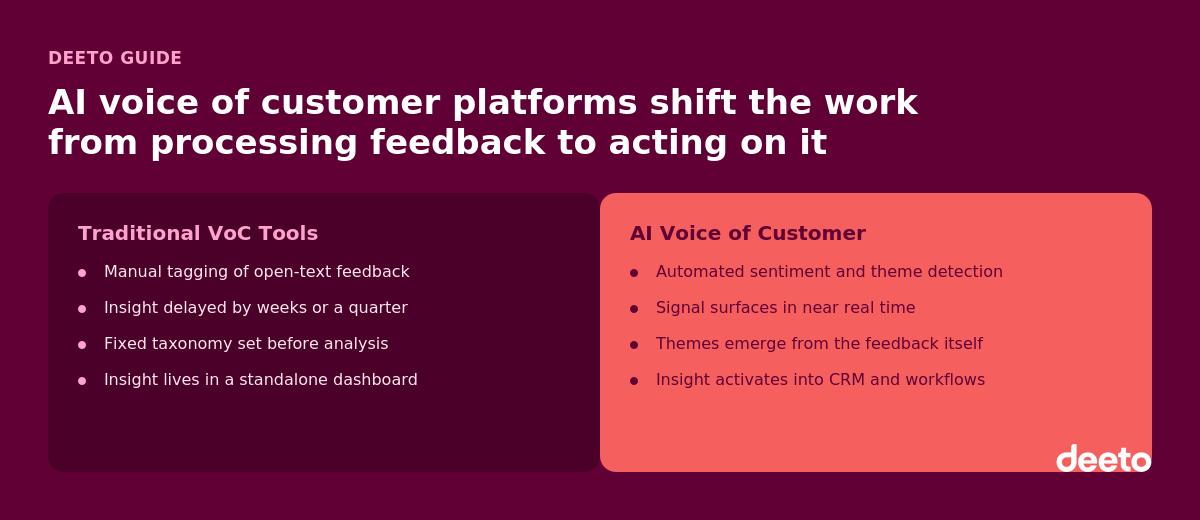
Traditional VoC tools collect feedback and report on structured metrics like NPS and CSAT well, but open-text analysis is largely manual. A researcher or analyst reads verbatims, tags themes by hand or with basic keyword rules, and builds reports on a delay, often weeks after the feedback came in.
AI voice of customer platforms apply natural language processing and machine learning to read every open-text response automatically. They detect sentiment, cluster feedback into themes without a predefined taxonomy, flag emerging issues as they appear, and route insight to the team that needs it, often within the same day feedback arrives.
The practical difference is what a team spends its time on. With a traditional tool, most of the effort goes into processing feedback. With an AI voice of customer platform, that effort shifts to acting on what the feedback already says.
Common Challenges with AI Voice of Customer Programs
AI makes VoC programs faster, but it doesn't remove every obstacle.
Fragmented sources are the most common one. Feedback lives in survey tools, support platforms, CRMs, review sites, and call recordings that don't talk to each other, so even a strong AI engine only sees part of the picture unless those sources are connected.
Accuracy and nuance are another challenge. Sarcasm, mixed sentiment in a single comment, and industry-specific language can trip up models that aren't tuned for your context, which is why it's worth looking for platforms that let you validate and refine categorization over time.
There's also the action gap. Collecting and analyzing feedback faster doesn't help if the insight still sits in a dashboard nobody checks. Insight needs to reach the person who can act on it, in the tool they already use.
Lastly, change management matters more than teams expect. Teams used to quarterly VoC reports need a different workflow to actually use real-time signals, and rolling out an AI voice of customer platform without adjusting how insights get reviewed and assigned limits the payoff.
Key Features to Look for in an AI Voice of Customer Platform
When evaluating platforms, prioritize:
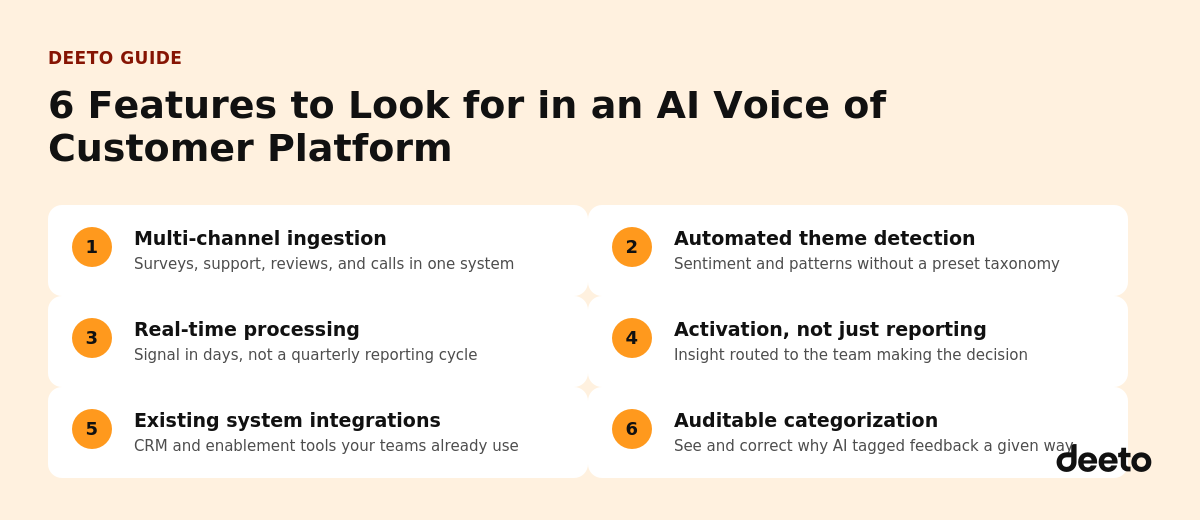
- Multi-channel ingestion: the ability to pull feedback from surveys, support tickets, reviews, sales calls, and in-product comments into one system, rather than analyzing each channel separately
- Automated theme and sentiment detection: AI that identifies patterns and emotional tone in open-text feedback without requiring a pre-built taxonomy
- Real-time or near-real-time processing: insight that reaches teams in days, not the weeks a manual review cycle takes
- Activation, not just reporting: the ability to route a specific insight or piece of proof to the team, workflow, or system where a decision is being made
- Integrations with existing systems: CRM, support, and enablement tools your teams already use, so insight shows up where work happens instead of a separate dashboard
- Transparent, auditable categorization: the ability to see why the AI tagged a comment the way it did, and to correct it, which matters for trust and for compliance-sensitive industries
How to Choose and Implement an AI Voice of Customer Platform
- Map your feedback sources first. List every channel where customer voice already lives, including channels no one currently analyzes, before evaluating tools.
- Define who needs the insight and how fast. A support team needs different signal speed than a product team building a quarterly roadmap. Match the platform's processing speed to that need.
- Test accuracy on your own data. Run a pilot with real feedback from your industry, not a generic demo dataset, since sentiment and theme detection accuracy varies by vocabulary and context.
- Check where insight actually lands. Ask whether the platform pushes insight into existing workflows (CRM, enablement tools, product boards) or only into its own dashboard.
- Plan the workflow change, not just the tool rollout. Assign ownership for reviewing and acting on real-time signals so faster insight actually translates into faster decisions.
Key Takeaways
- An AI voice of customer platform uses machine learning and NLP to automatically analyze open-text feedback at scale, instead of relying on manual coding.
- The core shift from traditional VoC tools is speed: AI-native platforms surface themes and sentiment in near real time rather than on a reporting cycle.
- Fragmented feedback sources and the gap between insight and action are the two biggest risks to a strong AI voice of customer program.
- The best platforms activate insight into existing workflows like CRM and sales enablement, not just a standalone dashboard.
- Piloting on your own feedback data, not a demo dataset, is the clearest way to judge whether a platform's AI actually understands your customers.
Deeto is built around that last point. The goal isn't a better dashboard, it's making sure insight actually reaches the team that owns customer voice, whether that's customer research feeding a positioning decision or sentiment analysis flagging a churn risk before a renewal call.
FAQs
What is an AI voice of customer platform?
An AI voice of customer platform is software that uses machine learning and natural language processing to automatically collect, analyze, and route customer feedback from channels like surveys, reviews, and support tickets. It identifies sentiment and themes in open-text feedback without manual coding, turning raw customer voice into structured, actionable insight.
How is an AI voice of customer platform different from a survey tool?
A survey tool collects structured responses like ratings and multiple-choice answers. An AI voice of customer platform goes further by analyzing open-text and unstructured feedback across many channels, using AI to detect sentiment and themes automatically rather than relying on a person to read and tag each response.
Can AI accurately analyze customer sentiment?
Modern AI voice of customer platforms are generally accurate at detecting sentiment and themes in customer feedback, though accuracy varies by vocabulary, industry, and language nuance. The best platforms let teams review and correct categorization, which improves accuracy over time and builds trust in the output.
Who should own an AI voice of customer program?
Ownership varies by company, but Customer Marketing, Product Marketing, and CX teams most commonly lead AI voice of customer programs, since they're closest to both the feedback and the decisions it informs. Successful programs usually have one team responsible for the system, with insight shared across sales, product, and support.
How long does it take to see value from an AI voice of customer platform?
Most teams see initial insight within weeks of connecting feedback sources, since AI analysis doesn't require the manual setup a traditional VoC program needs. Meaningful business impact, like faster response to emerging issues or better-informed product decisions, typically shows up over the following one to two quarters as workflows adjust to real-time signal.
Do AI voice of customer platforms replace human analysts?
No. AI handles the volume and speed of processing feedback, but people still decide what to do with the insight. The platforms that work best pair automated analysis with a clear owner who reviews signals and routes them to action.
Conclusion
An AI voice of customer platform doesn't change why listening to customers matters. It changes what's actually possible to do with everything customers are already saying. The teams getting ahead in 2026 aren't the ones running more surveys, they're the ones that can finally read all the feedback they already have, in time to act on it.
If you're on the team that owns customer voice at your company, see how customer insights translate into a real competitive advantage or book a demo to see Deeto in action.
🎉 Save your spot
Register for the event
Once your spot is secured, we’ll send your confirmation details.
Subscribe to our newsletter
Subscribe to receive the latest blog posts to your inbox every week.
By subscribing, you agree to our Privacy Policy
Subscribe to our newsletter
Get the latest news and updates from our team.
By subscribing, you agree to our Privacy Policy
Related posts

Call Intelligence Software That Spots Your Next Reference

What is call intelligence software? Learn how it scores every call automatically and surfaces advocacy-ready customers.

4 Ways To Leverage Social Proof In Marketing
What is social proof in marketing? Learn 4 ways to use reviews, stories, and advocacy to build buyer trust.

Customer Proof Marketing: How B2B Companies Build Trust with Buyers
What is customer proof marketing? Learn the proof types, frameworks, and software that build B2B buyer trust.